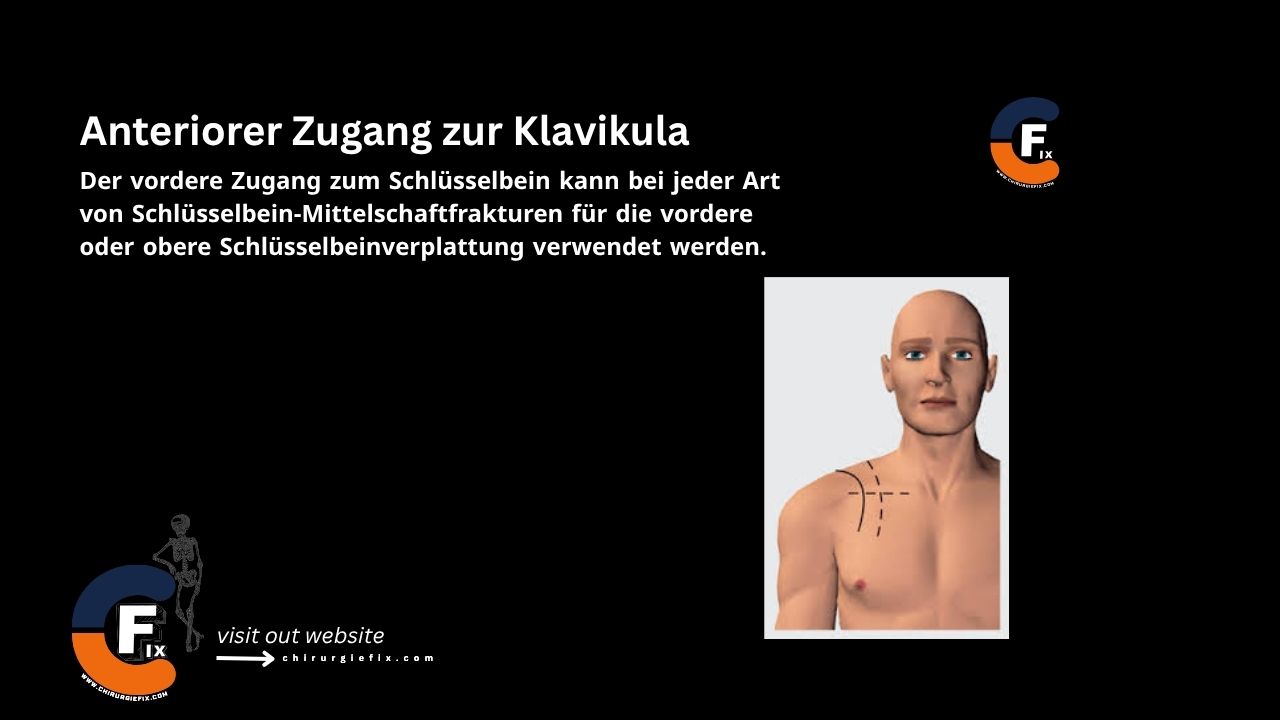
The anterior approach to the clavicle is suitable for managing any type of midshaft clavicle fracture when performing anterior or superior plate fixation.
Indications for the anterior approach to the clavicle include:
This surgical approach also provides access to the brachial plexus and the subacromial vessels when a clavicular osteotomy is required.
Clavicle fractures most commonly result from a direct blow or a fall onto an outstretched arm. They are among the most frequent fractures in the body. Read more >>>
The patient is placed in a supine position on the operating table. Break the table and elevate the head end to raise the shoulder region. Place a sandbag between the medial border of the scapula and the spine.
The sternal notch serves as the most medial landmark for the incision. Make an incision that follows the S-shaped contour of the clavicle, starting at the medial end.
There is no internervous plane for the anterior clavicular approach, as the dissection is performed directly on the subcutaneous surface of the clavicle.
Deepen the skin incision through the platysma muscle to reach the subcutaneous surface of the clavicle.
Carefully remove the soft tissue from the subcutaneous surface of the clavicle, staying in the epiperiosteal plane.
This approach can be extended longitudinally along the entire length of the clavicle if needed. The approach can also be extended distally to the proximal humerus and the humeral midshaft using the deltopectoral interval.
The structures at risk during the anterior approach to the clavicle include: