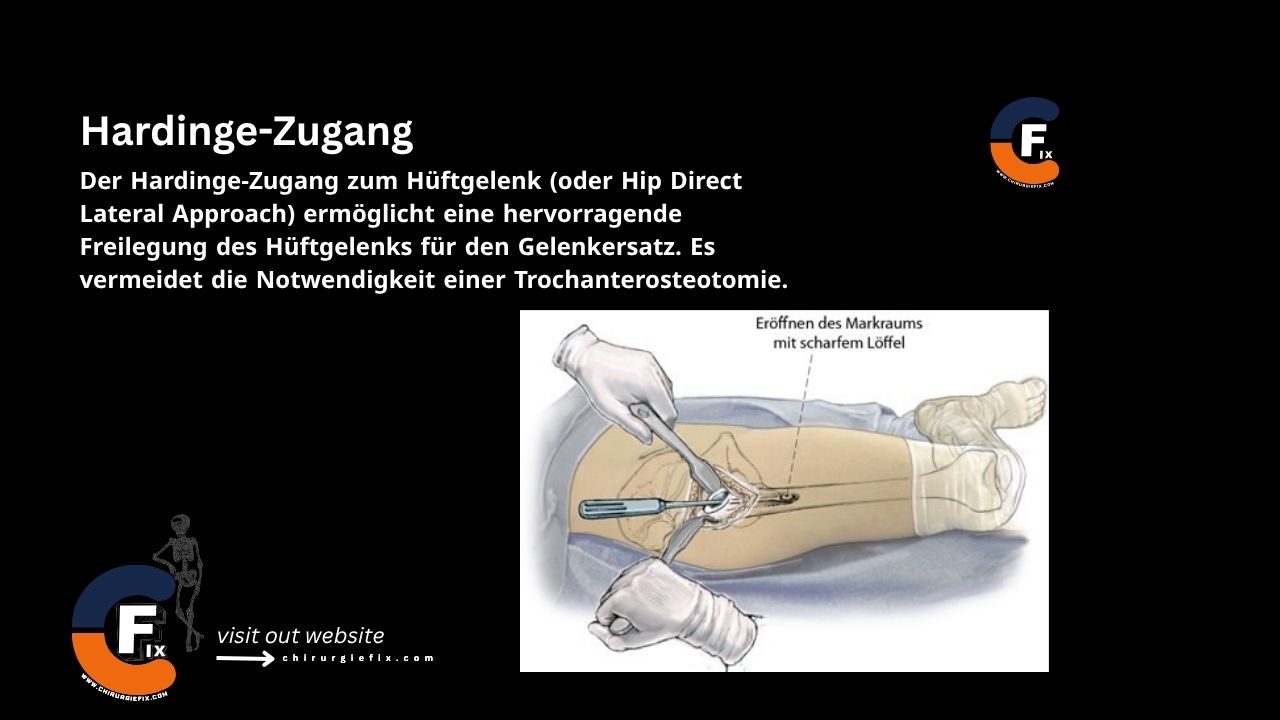
The Hardinge approach to the hip joint (also known as the direct lateral approach) provides excellent exposure for hip replacement surgery. This technique eliminates the need for a trochanteric osteotomy.
It is important to note that this approach offers less extensive exposure than the anterolateral approach, which does require a trochanteric osteotomy.
The Hardinge approach is used for:
There is no true internervous plane for the Hardinge approach. The fibers of the gluteus medius muscle are split in line, distal to the point where the superior gluteal nerve supplies the muscle. The vastus lateralis muscle is also split in line, lateral to the point where it is innervated by the femoral nerve.
Distal Extension:
The Hardinge approach can be easily extended distally. To expose the femoral shaft, split the vastus lateralis muscle in line with its fibers (as in a lateral approach to the femur).
Proximal Extension:
The Hardinge approach cannot be extended proximally.
Structures at risk during the Hardinge approach include: