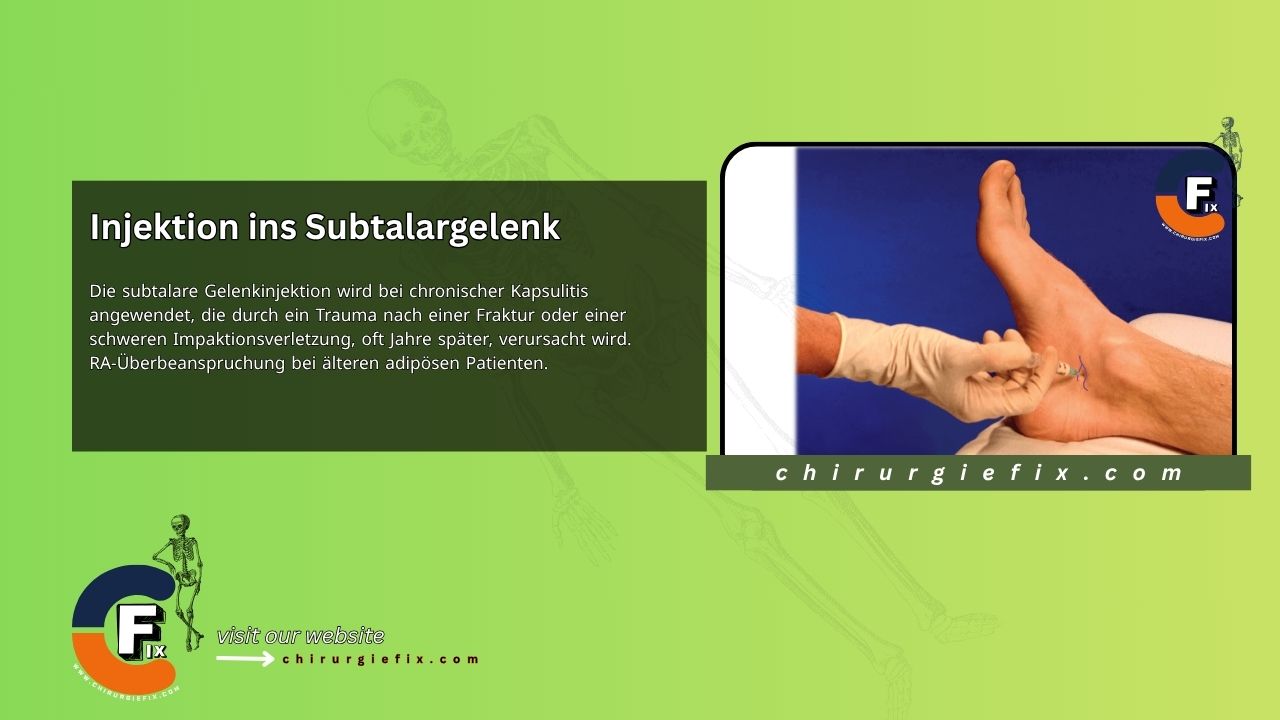
The subtalar joint injection is a treatment approach for chronic capsulitis often resulting from trauma following a fracture or a severe impaction injury, sometimes occurring years later. It is also used in cases of rheumatoid arthritis overuse in older, obese patients.
Chronic capsulitis of the subtalar joint is characterized by deep pain on both the medial and lateral sides of the heel. Clinically, it presents with passive adduction of the calcaneus.
The subtalar joint is divided into anterior and posterior compartments by an oblique septum. A simpler approach involves entering the joint just above the sustentaculum tali, a bony prominence approximately one thumb's width directly below the medial malleolus (inner ankle bone).
Required Equipment
- Syringe: 2 ml
- Needle: Blue, 23 Gauge, 1.25 inches (30 mm)
- Kenalog 40: 30 mg
- Lidocaine: 1.25 ml, 2%
- Total volume: 2 ml
Subtalar Joint Injection Technique
- Position the patient on their side and support the foot, ensuring the medial side of the heel faces upward.
- Identify the bony prominence of the sustentaculum tali.
- Insert the needle perpendicularly, directly above and slightly behind the sustentaculum tali.
- Deposit half of the solution at this location.
- Withdraw the needle slightly and angle it obliquely forward, passing through the septum into the anterior compartment of the joint space.
- Deposit the remaining solution at this location.
After a subtalar joint injection, avoid excessive weight-bearing until pain subsides. Orthotics and weight management are helpful to prevent recurrence.
Notes
The subtalar joint injection is technically challenging due to the joint's anatomy. If the needle does not enter the joint immediately, apply a small amount of the mixed solution to the area. This allows for more comfortable subsequent attempts to place the needle intra-articularly. The procedure can be repeated at irregular intervals if needed.
Ultrasound-guided subtalar joint injection is a valuable orthopedic technique offering several benefits:
- Increased accuracy: Ultrasound guidance enables precise needle placement within the subtalar joint, minimizing the risk of unintended tissue damage and maximizing injection efficacy.
- Real-time visualization: Dynamic, real-time imaging allows visualization of the needle path, ensuring correct positioning and avoidance of critical structures.
- Improved patient comfort: Precise medication delivery to the target site often results in less pain and improved joint function for patients.
- Minimized adverse effects: Ultrasound guidance permits the use of smaller needle sizes, reducing the likelihood of complications such as bleeding, infection, or nerve injury.
With appropriate training and practice, the subtalar joint can be reliably and safely targeted using an ultrasound-guided corticosteroid injection to manage symptoms associated with juvenile idiopathic arthritis.
Intra-articular subtalar joint steroid injections have been used anecdotally in patients with symptomatic talocalcaneal coalitions. This procedure does not appear to reduce the need for surgery compared to conventional non-operative therapies. However, in patients who fail other forms of conservative treatment, subtalar steroid injections may delay surgical intervention by an average of nearly two years.
References
- Injection Techniques in Musculoskeletal Medicine. A Practical Manual for Clinicians in Primary and Secondary Care. Fifth Edition.
- Zide Jr, Shivers C, Adair C, Le TY, Rathjen K, Jo CH, Riccio AI. The Effectiveness of Intra-articular Subtalar Steroid Injection for Symptomatic Talocalcaneal Coalitions: A 30-Year Single-Institution Experience. J Pediatr Orthop. 2022 May-Jun 01;42(5):e453-e459. DOI: 10.1097/BPO.0000000000002093. PMID: 35250016.
- Young CM, Horst DM, Murakami JW, Shiels WE 2nd. Ultrasound-guided corticosteroid injection of the subtalar joint for the treatment of juvenile idiopathic arthritis. Pediatr Radiol. 2015 Jul;45(8):1212-7. doi: 10.1007/s00247-015-3291-2. Epub 2015 Feb 12. PMID: 25672519.