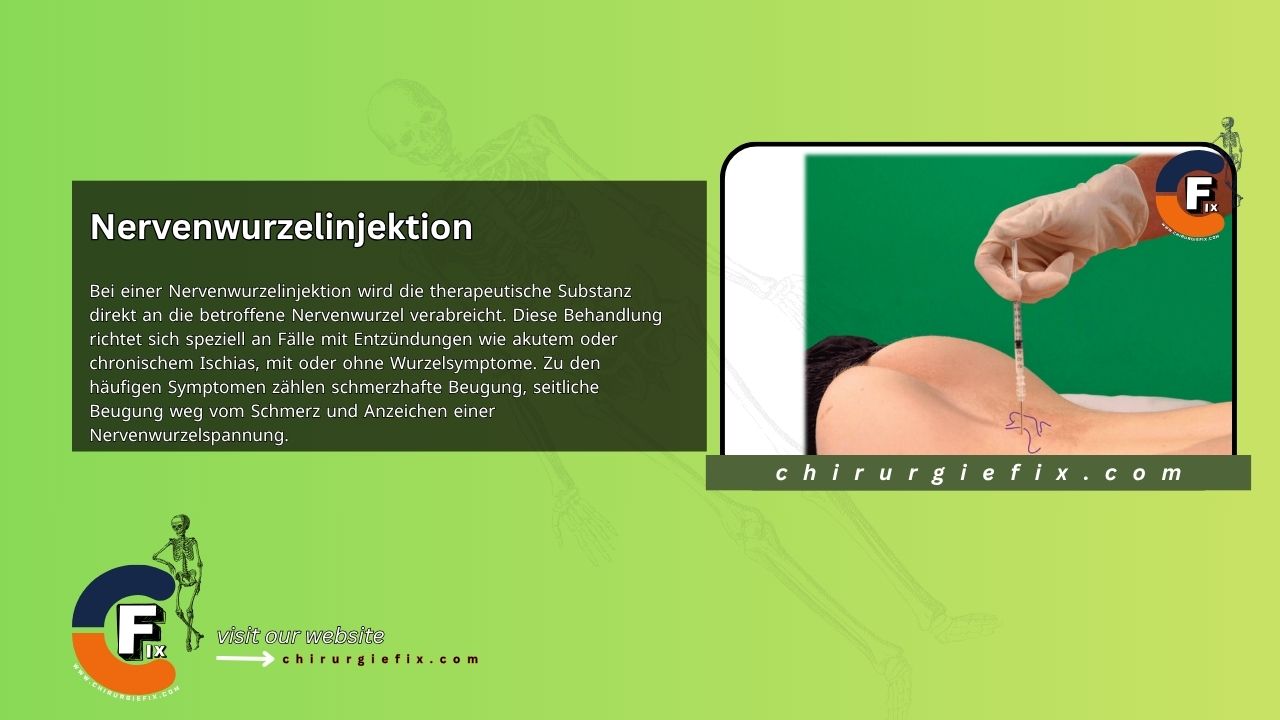
A nerve root injection delivers a therapeutic substance directly to the affected nerve root. This treatment is specifically indicated for inflammatory conditions such as acute or chronic sciatica, with or without associated nerve root symptoms. Common symptoms include painful forward bending, side-bending away from the pain, and signs of nerve root tension.
The lumbar nerve roots exit the spinal canal diagonally, lying between the transverse processes at the same level as the spinous process. To locate the injection site, imagine a vertical line running through the center of the spinous processes. Then, draw horizontal lines aligned with each spinous process. The approximate needle entry point is about one thumb’s width lateral to this horizontal line.
The patient remains mobile within their pain limits and should be reassessed in one week or 10 days. The nerve root injection can be repeated as needed.
This injection can provide significant relief, particularly for severe pain when conventional manual therapy techniques are not feasible. It may also be considered if previous attempts at caudal epidural injection have been unsuccessful. Although the caudal technique is technically simpler, there is a risk that the solution may not effectively reach the affected nerve root area. If the first injection does not relieve symptoms, alternative levels above or below can be targeted. This is a worthwhile approach before considering surgical options.
If the needle contacts bone at about 2 inches (≈5 cm), indicating contact with the lamina or facet joint, it must be repositioned. If the patient reports a strong electric shock sensation, suggesting nerve root contact, the needle also needs to be repositioned. It is possible to infiltrate two levels at once, but a longer needle may be required for larger patients.
If aspiration reveals clear fluid, indicating an intrathecal needle position, the procedure must be abandoned. It can be attempted again after a few days.
Study: A therapeutic selective nerve root block (SNRB injection) is an important procedure for managing pain in patients with lumbar radiculopathy caused by lumbar disc herniation and foraminal stenosis. This study showed that surgery could be avoided in up to 54% of patients. In up to 29% of patients, a single selective nerve root block provided pain relief for at least 6 months. This makes it a very good second-line treatment after conservative care and a potential method to delay or even avoid the need for surgery.