Nerve Block for Hand Surgery
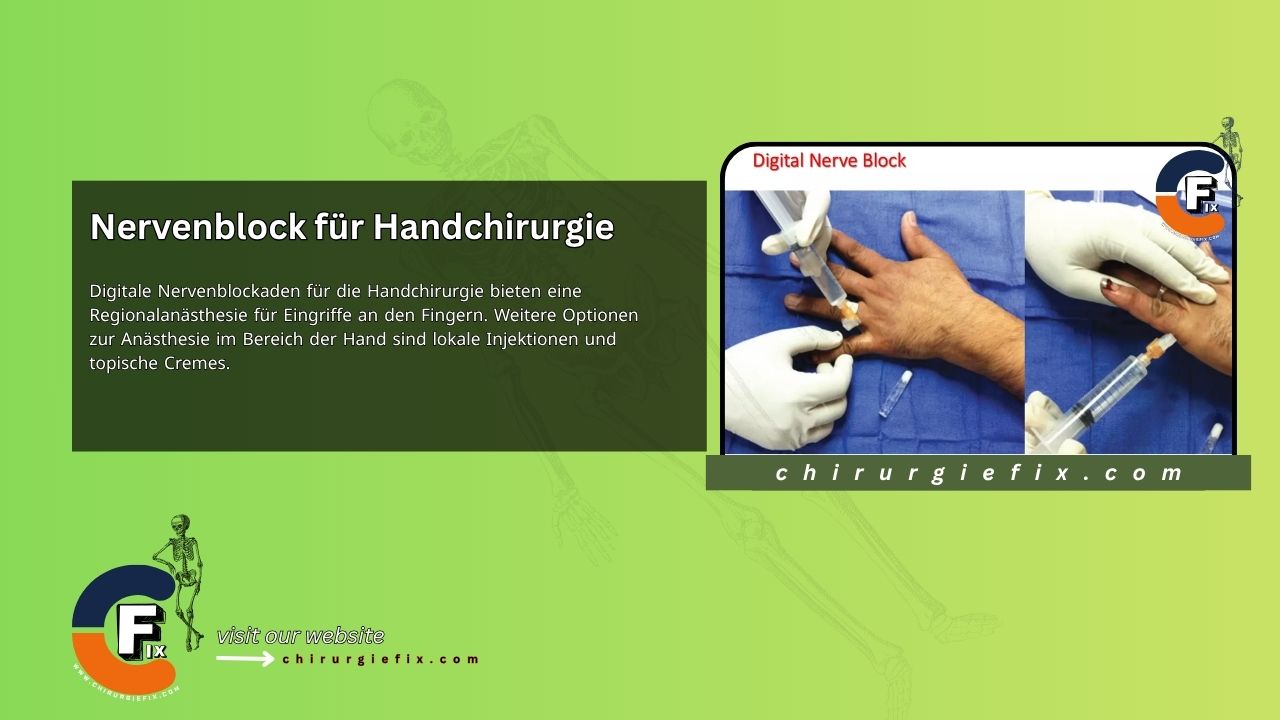
Digital nerve blocks provide regional anesthesia for procedures on the fingers. Other options for hand anesthesia include local injections and topical creams.
Nerve Block vs. Local Injection
- Less painful procedure: Due to the sensitivity of the palm, local injections can be quite painful and less effective compared to a nerve block.
- Digital nerve blocks numb a larger area.
- They typically use a smaller amount of anesthetic.
- They help prevent further distortion of injured tissue compared to local injection.
- The onset of a nerve block usually takes several minutes.
- Nerve blocks are more technically challenging to perform.
- Accidental injection into a systemic blood vessel is more common.
- With a nerve block, the injection site can become very tense, potentially affecting digital blood circulation.
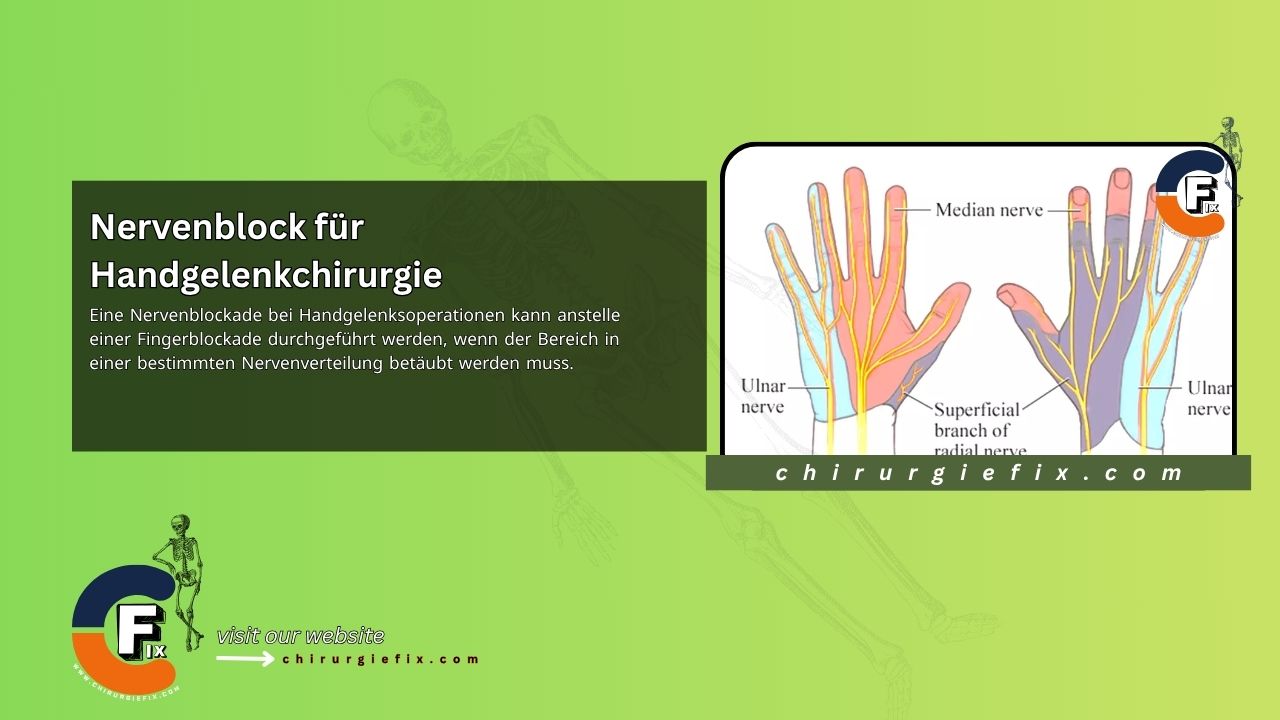
Each finger is innervated by two digital nerves that originate from the median or ulnar nerve. To perform surgery on a finger, both nerves must be blocked. Sensation on the dorsal side of the finger is provided by branches of the digital nerves that run dorsally at each joint. A digital nerve block can achieve adequate anesthesia for all procedures distal to the proximal phalanx.
For more proximal anesthesia, a wrist block is more effective. Procedures on the dorsum of the hand and skin require a nerve block involving the superficial branch of the radial nerve and/or the dorsal branch of the ulnar nerve. Digital blood vessels run along the flexor tendon sheath with the nerves.
Indications and Contraindications for Digital Nerve Blocks
Indications for digital nerve blocks include:
- Lacerations beyond the middle and distal phalanx
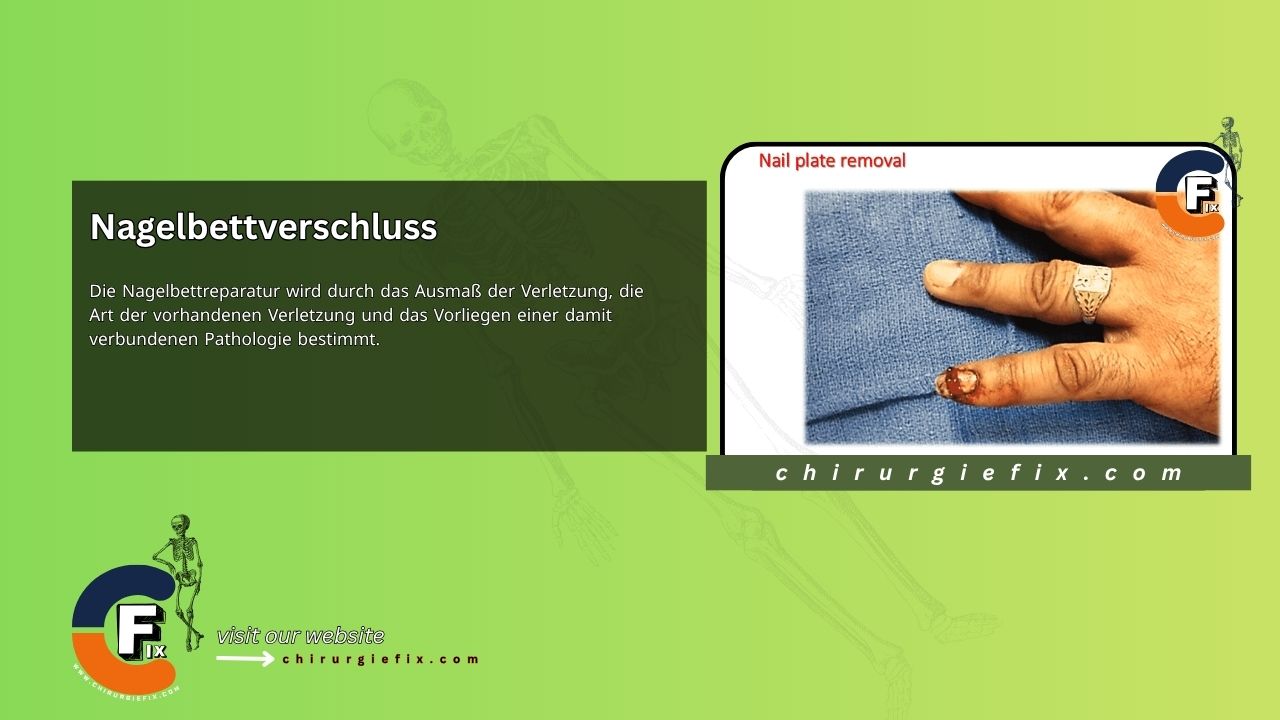
- Nail bed injuries
- Foreign bodies in the finger
- Finger fractures
- Finger and/or nail bed infections
Contraindications for digital nerve blocks include:
- Infection of the tissue through which the needle will pass
- Compromised blood supply
- An allergy to the anesthetic
Epinephrine should not be used in digital nerve blocks, especially in patients at risk for finger infarction or ischemia, such as those with peripheral vascular disease or diabetes mellitus. Epinephrine constricts blood vessels and should be avoided due to the proximity of the digital arteries to the digital nerves.
Nerve Block Techniques for Hand Surgery
Several techniques are used for performing digital nerve blocks:
- Single subcutaneous palmar injection digital block
- Traditional digital block
- Transthecal block
Single digital blocks through a subcutaneous palmar injection were found to be as painful as traditional digital blocks. Transthecal blocks were found to be more painful than the other two. This may be because the latter technique injects anesthetic into the flexor tendon sheath, which has little space, creating higher hydraulic pressure and increasing pain. A disadvantage of the palmar block technique may be inadequate anesthesia of the dorsum of the finger, as the sensory nerves on the back may not always be blocked.
Advantages of the transthecal digital block include:
- A single injection that numbs the entire finger
- Less anesthetic required
- Faster onset of anesthesia
- Low risk of trauma to the neurovascular bundles
Disadvantages include:
- Increased pain even after the anesthesia wears off
- A more technically challenging procedure
Required Materials
- A syringe with an 18- to 22-gauge needle for drawing up the anesthetic
- Local anesthetic (e.g., Lidocaine 1%), without epinephrine and buffered with a 1:10 ratio of 8.4% sodium bicarbonate
- A 27- to 30-gauge needle for performing the injection
For any technique, thoroughly prepare the area to be injected and/or sutured with alcohol, iodine, or chlorhexidine before the injection.
Finger Web Space Nerve Block
- Pronate the patient’s hand and place it flat on a sterile drape. The dorsum of the hand is less sensitive to pain than the palm.
- Insert the needle perpendicular to the finger into the subcutaneous tissue of the web space, just distal to the MCP joint.
- Slowly aspirate to ensure the needle is not in a digital blood vessel.
- Inject 2 ml of anesthetic into the subcutaneous dorsal tissue, infiltrating the tissue around the dorsal nerve.
- Slowly advance the needle toward the palmar surface, injecting another 2 ml of anesthetic as the needle moves. This should infiltrate the tissue around the palmar nerve. Do not push through the palmar skin surface.
- Withdraw the needle and repeat these steps on the opposite side of the finger. Use 2 ml of anesthetic per nerve (for a total of 8 ml).
- Do not close the bridge dorsally. It is important not to create a ring block by infiltrating the anesthetic circumferentially, as this can compromise blood supply.
Transthecal Digital Nerve Block
The transthecal digital nerve block is performed by injecting a local anesthetic into the flexor tendon sheath. This technique was first described by Chiu in 1990.
- Palpate the distal palmar crease and flex the finger to make the flexor tendon easier to identify.
- Supinate the patient’s hand and place it flat on a sterile drape.
- Insert the needle (without the syringe attached) at a 45° angle, penetrating the skin surface just distal to the distal palmar crease.
- Advance the needle into the flexor tendon sheath.
- To confirm needle placement, passively flex and extend the finger. If the needle is in the sheath, it should swing in an arc with the tendon movement.
- Attach the syringe and slowly inject the anesthetic (2 ml). The anesthetic should flow easily into the tendon sheath.
A modified transthecal digital nerve block is described:
- Position the patient’s hand with the palm facing up.
- Insert the needle at a 90-degree angle at the mid-palmar crease until bone is contacted.
- Withdraw the needle slightly and inject the anesthetic.
- During the injection, use your non-dominant hand to apply pressure just proximal to the injection site to direct the flow distally.
Notes
In a randomized controlled trial, it was found that digital block and local anesthesia for finger lacerations with prior application of Lidocaine-Epinephrine-Tetracaine (LET) to all wounds resulted in similar pain during needle insertion, anesthetic infiltration, and suturing.
References
- Chale S, Singer AJ, Marchini S, McBride MJ, Kennedy D. Digital versus local anesthesia for finger lacerations: a randomized controlled trial. Acad Emerg Med. 2006 Oct;13(10):1046-50. doi: 10.1197/j.aem.2006.06.048. Epub 2006 Sep 13. PMID: 16973640.
- Morrison WG. Transthecal digital block. Arch Emerg Med. 1993 Mar;10(1):35-8. doi: 10.1136/emj.10.1.35. PMID: 8452611; PMCID: PMC1285922.
- Chiu DT. Transthecal digital block: flexor tendon sheath used for anesthetic infusion. J Hand Surg Am. 1990;15(3):471-3.
- Egol Kenneth A, Kenneth J Koval, Joseph D Zuckerman. Handbook of Fractures, 4th ed. Philadelphia, PA: Lippincott Williams & Wilkins; 2010. p. 68-9.
- Yin ZG, Zhang JB, Kan SL, et al. A comparison of traditional digital blocks and single subcutaneous palmar injection blocks at the base of the finger and a meta-analysis of digital block trials. Journal of Hand Surgery (British and European Volume). 2006;31(5):547-55.
- Flarity-Reed K. Methods of digital block. J Emerg Nurs. 2002 Aug;28(4):351-4. doi: 10.1067/men.2002.125539. PMID: 12122413.
- Orthopedic Procedures in the Emergency Department: An Illustrative Guide for the House Officer by Eric J. Strauss and Kenneth A. Egol