What Is an AC Joint Injection?
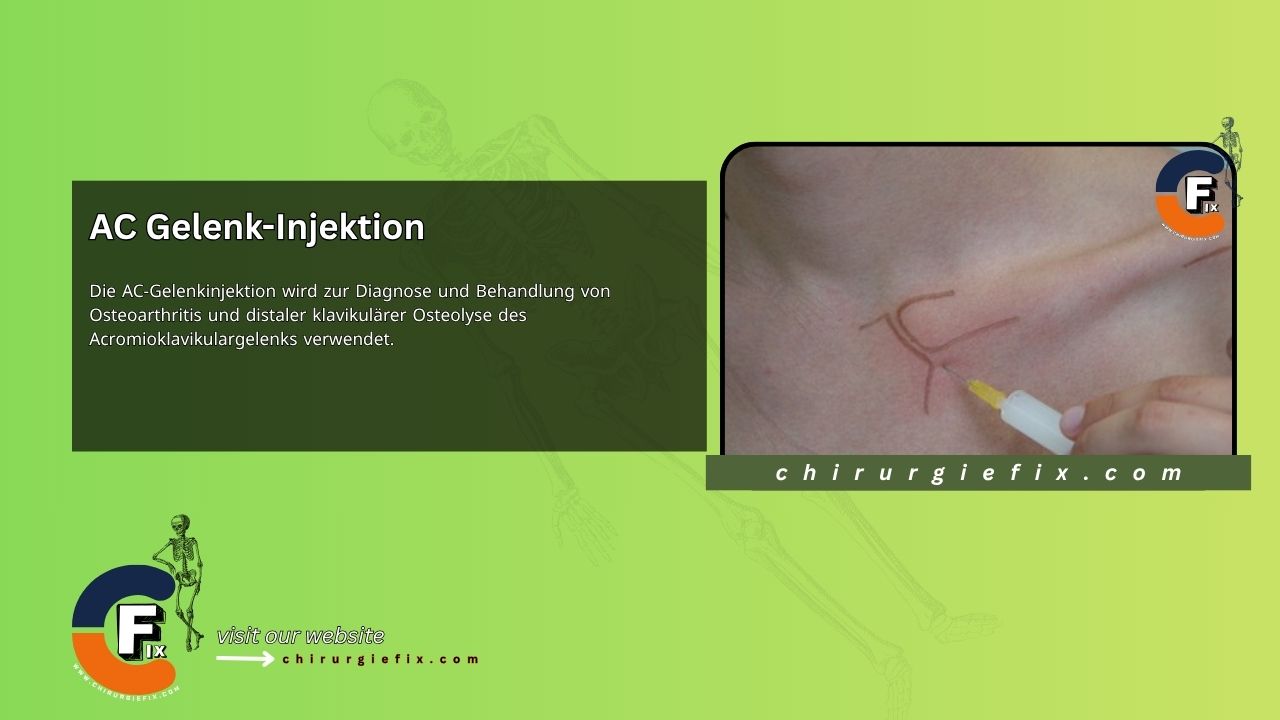
An AC joint injection is used for both diagnosing and treating osteoarthritis and distal clavicular osteolysis of the acromioclavicular joint.
AC joint pain can be either traumatic or non-traumatic:
- Traumatic AC joint pain typically results from a direct blow to the top or side of the shoulder. The impact can cause partial or complete tearing of the ligaments within the joint, commonly known as a shoulder separation. This injury is frequent in contact sports such as football and hockey.
- The most common non-traumatic causes of AC joint pain are overuse, degenerative changes, and distal clavicle osteolysis.
Related Anatomy
The joint line of the acromioclavicular joint runs in the sagittal plane, approximately one thumb’s width medial to the lateral edge of the acromion. The joint plane runs obliquely, medially from top to bottom, and usually contains a small meniscus. A small step-off where the acromion meets the clavicle, or a slight V-shaped gap at the anterior joint margin, can often be felt. Passively gliding the acromion downward on the clavicle can help locate the joint line.
Required Equipment
The equipment and tools needed for an AC joint injection include:
AC Joint Injection Technique
- The patient sits supported with their arms hanging down at their sides to help keep the joint surfaces slightly separated.
- Identify the lateral edge of the acromion. Move your palpating finger about one thumb’s width medially and mark the center of the joint line.
- Insert the needle at a medial angle of approximately 30 degrees to the vertical, crossing the capsule.
- Inject the solution as a bolus.
Post-Treatment Care
Reassess the patient and have them passively move the shoulder to check for clinical improvement.
Begin gentle mobilization exercises as soon as possible. For acute joint inflammation, ice application, stabilizing tape on the joint, and oral pain relievers can help.
Contraindications
Contraindications for AC joint injection include:
- Septic arthritis of the AC joint.
- Cellulitis in the injection area.
- Hypersensitivity or a known allergy to the injected solution.
- Skin damage at the injection site.
- A fracture at the intended injection site.
- Caution is advised for patients on anticoagulation therapy or with known bleeding disorders.
Notes
- Access to the joint can sometimes be difficult; it is usually a tight space that can be further narrowed by degenerative changes. Pulling on the arm may help open the joint space.
- To avoid unnecessary pain, anesthetize the capsule by instilling the solution as the needle probes for the joint space.
- If access from above is difficult, the AC joint can also be injected from the front, horizontally, at the V-shaped anterior gap.
- For an unstable or repeatedly subluxating joint, sclerosing injections or, if needed, surgery may help.
References
- Merrigan B, Varacallo M. Acromioclavicular Joint Injection. [Updated May 8, 2022]. In: StatPearls [Internet]. Treasure Island (FL): StatPearls Publishing; 2022 Jan-. Available from: https://www.ncbi.nlm.nih.gov/books/NBK547727/
- Saccomanno MF, DE Ieso C, Milano G. Acromioclavicular joint instability: anatomy, biomechanics and evaluation. Joints. 2014 Apr-Jun;2(2):87-92.