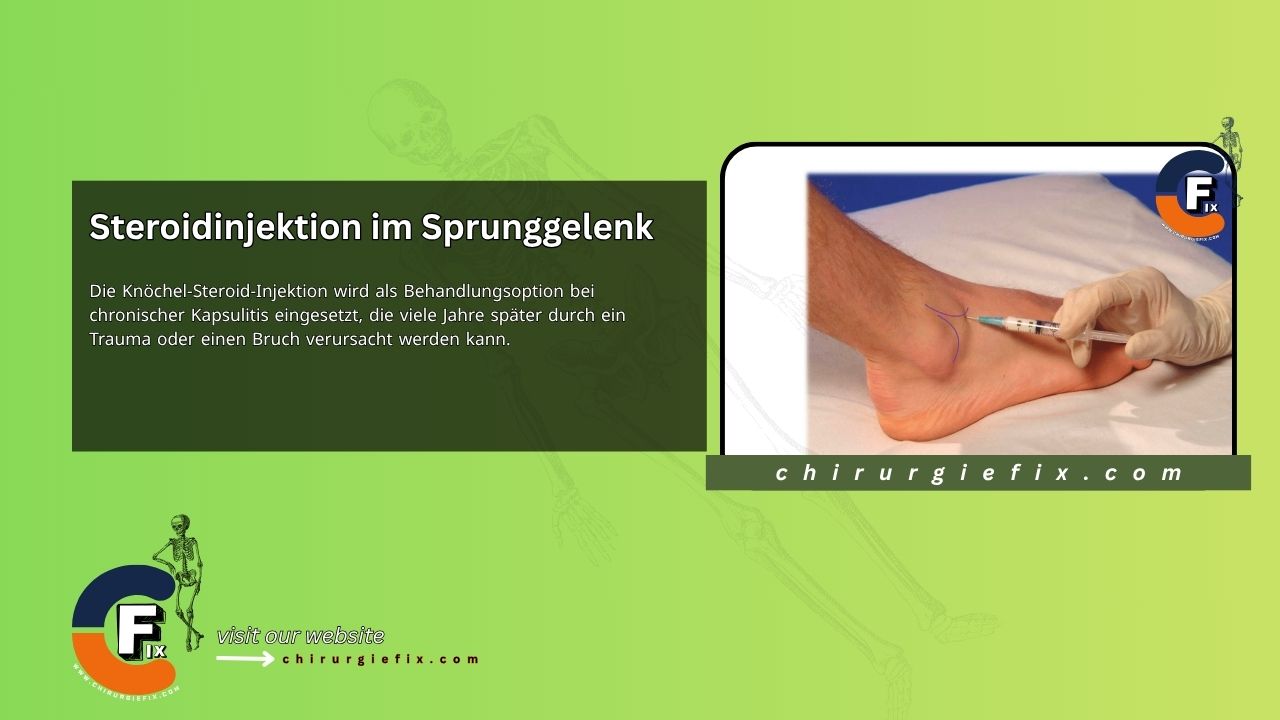
Injection into the peroneal tendons
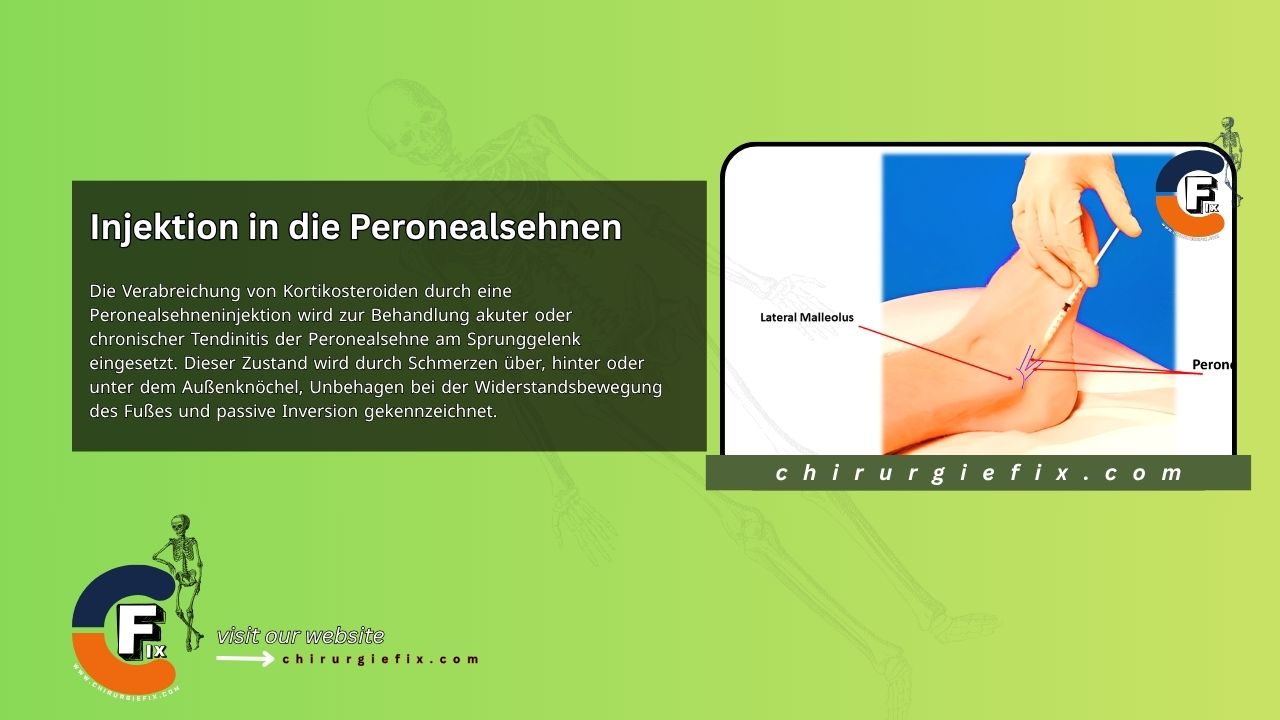
The administration of corticosteroids via a peroneal tendon injection is used to treat acute or chronic tendinitis of the peroneal tendons at the ankle. This condition is characterized by pain over, behind, or below the lateral malleolus, discomfort with resisted foot eversion, and passive inversion.
Required equipment:
- Syringe: 1 mL capacity
- Needle: Orange, 25 Gauge, 0.5 inch (13 mm)
- Kenalog: 10 mg
- Lidocaine: 0.75 mL, 2%
- Total volume: 1 mL
Related anatomy
The peroneus longus and peroneus brevis tendons run together within a synovial sheath behind the lateral malleolus. The longus tendon then splits off, runs under the foot arch, and attaches to the base of the first metatarsal. Meanwhile, the brevis tendon attaches to the base of the fifth metatarsal.
The point where these two tendons divide serves as the entry point for a needle inserted into the sheath. This point can be located by having the patient strongly evert their foot and palpating the V-shaped separation of the tendons.
Peroneal tendon injection technique
Technique for peroneal tendon injection with corticosteroids:
Pre-procedure preparation:
- Explain the procedure to the patient, including its purpose and potential risks.
- Obtain the patient’s informed consent.
- Ensure the patient is comfortably seated or lying down with the affected leg accessible.
- Sterilize the injection site and surrounding area with a suitable antiseptic solution.
Identify the peroneal tendon:
- Palpate the area around the lateral malleolus to locate the peroneal tendons.
- The tendons are typically located behind the bony prominence, with the peroneus brevis tendon positioned more posteriorly and the peroneus longus tendon more anteriorly.
Skin preparation and local anesthesia:
- Clean the skin over the injection site with an antiseptic solution.
- Administer a local anesthetic (e.g., lidocaine) to numb the injection site using a small-gauge needle and proper aseptic technique.
Needle insertion:
- Hold the syringe with the medication in one hand and a sterile needle in the other.
- Insert the needle at a 45-degree angle or perpendicular to the skin, aiming for the area near the peroneal tendon.
- Advance the needle slowly and carefully, keeping it parallel to the tendon fibers to avoid injury.
Aspiration and injection:
- Once the needle is correctly positioned near the peroneal tendon, gently pull back the plunger to aspirate and confirm the needle is not within a blood vessel.
- If no blood is aspirated, slowly inject the medication into the peroneal tendon sheath or the space adjacent to the tendon, as directed by the treating physician.
- Maintain steady pressure on the plunger during the injection to ensure even distribution of the medication.
Needle removal and post-procedure care:
- Gently withdraw the needle and apply a sterile dressing to the injection site.
- Instruct the patient on post-procedure care, which may include avoiding strenuous activities, applying ice, or taking prescribed medications.
- Provide any necessary post-injection instructions and schedule follow-up appointments as needed.
Notes
This type of injury is often associated with an acute lateral ankle ligament sprain. A thorough examination of the joint is necessary to determine if multiple ligaments are involved. If needed, all affected ligaments should be treated. If there is uncertainty regarding a tendon rupture, it is advisable to first obtain an imaging scan.
Sometimes, tendinitis manifests at the insertion point of the peroneus brevis. In such cases, the same volume of solution should be evenly distributed at the teno-osseous junction. This is achieved by inserting the needle parallel to the skin until it reaches the base of the fifth metatarsal.
Less commonly, a sprain of the flexor tendons on the medial side of the foot may occur, with symptoms including pain on resisted flexion and inversion. The recommended dosage and volume for the peroneal tendon injection remain as previously mentioned.
References and further reading
- Walt J, Massey P. Peroneal Tendon Syndromes. [Updated 2023 May 23]. In: StatPearls [Internet]. Treasure Island (FL): StatPearls Publishing; 2023 Jan-. Available from: https://www.ncbi.nlm.nih.gov/books/NBK544354/
- Fram BR, Rogero R, Fuchs D, Shakked RJ, Raikin SM, Pedowitz DI. Peroneal Tendon Sheath Ultrasound-Guided Corticosteroid Injection: Clinical Outcomes and Complications. Foot Ankle Orthop. 2019 Oct 28;4(4):2473011419S00048. DOI: 10.1177/2473011419S00048. PMCID: PMC8696808.
- Injection Techniques in Musculoskeletal Medicine. A Practical Manual for Clinicians in Primary and Secondary Care. Fifth Edition.