Subcutaneous access to the ulnar shaft

Introduction

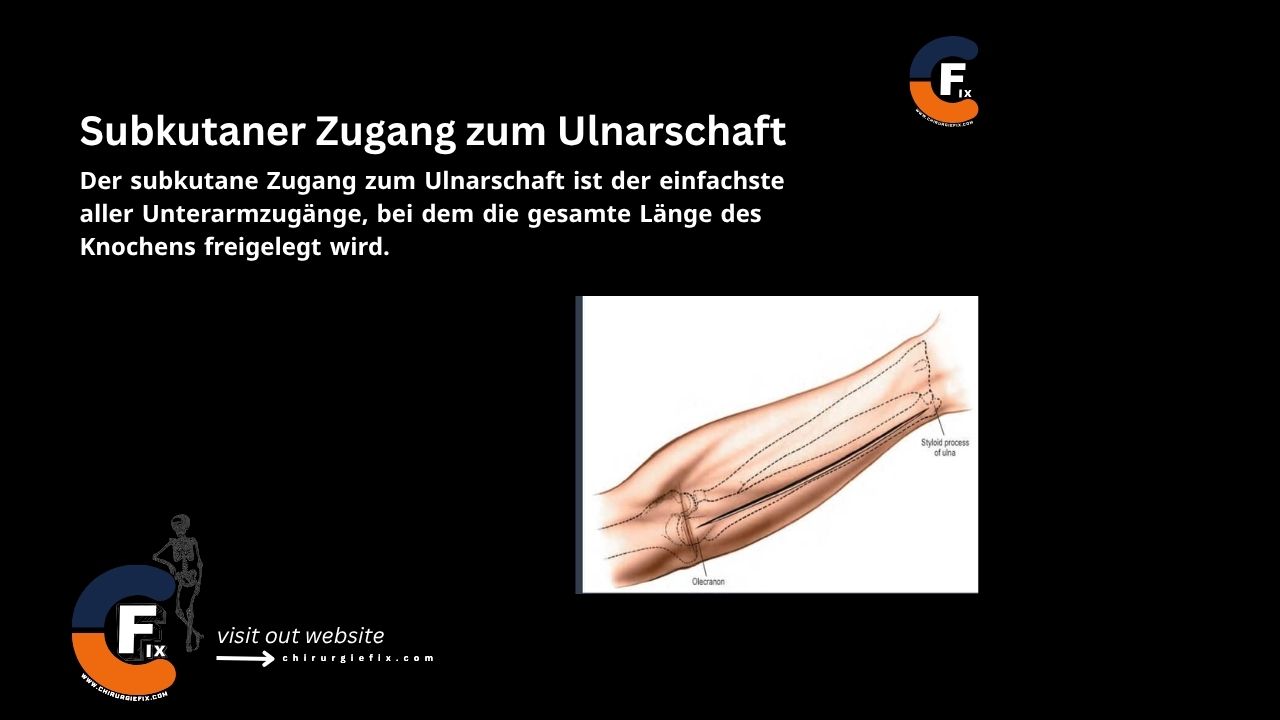
The subcutaneous approach to the ulnar shaft is the simplest of all forearm approaches, providing exposure to the entire length of the bone.

Indications

This approach is used for a variety of procedures, including:

  1. Open reduction and internal fixation of ulnar fractures.
  2. Treatment of delayed union or nonunion of ulnar fractures.
  3. Ulnar osteotomy.
  4. Treatment of chronic osteomyelitis.
  5. Management of the fibrous ulnar anlage in ulnar clubhand.
  6. Ulnar lengthening (for Kienböck’s disease).
  7. Ulnar shortening (for distal radius malunion).

Patient Positioning

  • Place the patient supine on the operating table and position the arm across the chest. This exposes the subcutaneous border of the ulna.
  • Alternatively, flex the elbow to 90° and rest it on the table. Have the surgical assistant hold the patient’s hand so the forearm is vertical.

Landmarks and Incision

Landmarks: The subcutaneous border of the ulna.

Incision: Palpate the subcutaneous ulnar border. Make a linear, longitudinal incision directly over this border. The incision length depends on how much bone needs to be exposed. In the case of a fracture, center the incision over the fracture site.

Internervous Plane

The internervous plane for the subcutaneous approach to the ulnar shaft lies between:

  • The extensor carpi ulnaris (ECU) muscle, which is innervated by the posterior interosseous nerve.
  • The flexor carpi ulnaris (FCU) muscle, which is innervated by the ulnar nerve.

Superficial Dissection

  • Incise the deep fascia distally along the line of the skin incision.
  • Develop the plane between the extensor carpi ulnaris and flexor carpi ulnaris muscles.
  • Dissect down to the subcutaneous border of the ulna. In the middle third of the ulna, fibers of the extensor carpi ulnaris must be divided to reach the bone.

Deep Dissection

  • Incise the periosteum over the ulna and perform subperiosteal dissection.
  • In the proximal fifth of the ulna, some of the triceps tendon attachment must be released to gain access to the bone.

Approach Extension

  • Distal extension of the approach is not useful.
  • Proximally, the approach can be extended over the olecranon and up the back of the arm (posterior approach to the elbow joint).

Dangers

Structures at risk during the subcutaneous approach to the ulnar shaft include:

  1. Ulnar nerve:
    • Proximally, the ulnar nerve passes through the two heads of the flexor carpi ulnaris muscle.
    • It runs along the forearm under the flexor carpi ulnaris and over the flexor digitorum profundus.
    • It is protected by subperiosteal elevation of the flexor carpi ulnaris.
  2. Ulnar artery:
    • The ulnar artery runs along the forearm with the ulnar nerve.
    • The ulnar artery lies radial to the ulnar nerve.
    • It is protected by subperiosteal elevation of the flexor carpi ulnaris.

References

  • Book: "Surgical Exposures in Orthopaedics" – 4th edition
  • Campbell's "Operative Orthopaedics", 12th edition

Still to read...