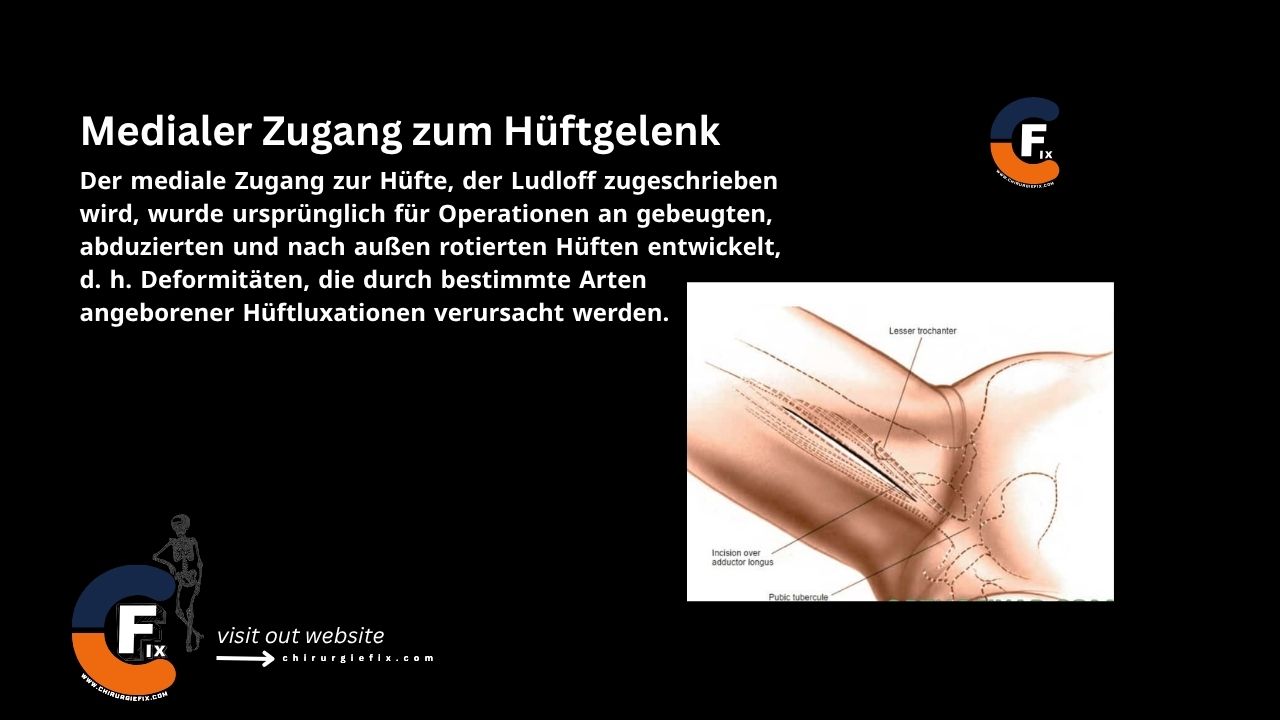
The medial approach to the hip, attributed to Ludloff, was originally developed for surgeries on hips that are flexed, abducted, and externally rotated—deformities caused by certain types of congenital hip dislocations.
This surgical approach is used for several procedures, including:
There is no superficial internervous plane for the medial approach to the hip. Both the adductor longus and gracilis muscles are innervated by the anterior branch of the obturator nerve.
The deep internervous plane for the medial approach to the hip joint lies between the adductor brevis and adductor magnus muscles.
Structures at risk during the medial approach to the hip joint include:
The adductor compartment of the thigh consists of three muscle layers. The two branches of the obturator nerve run between each pair of layers.
The adductor longus is the only muscle of the adductor group that is easily palpable at its tendinous origin. Its structure is examined in detail during the superficial surgical dissection.