Dorsomedial approach to the MTP joint

Introduction

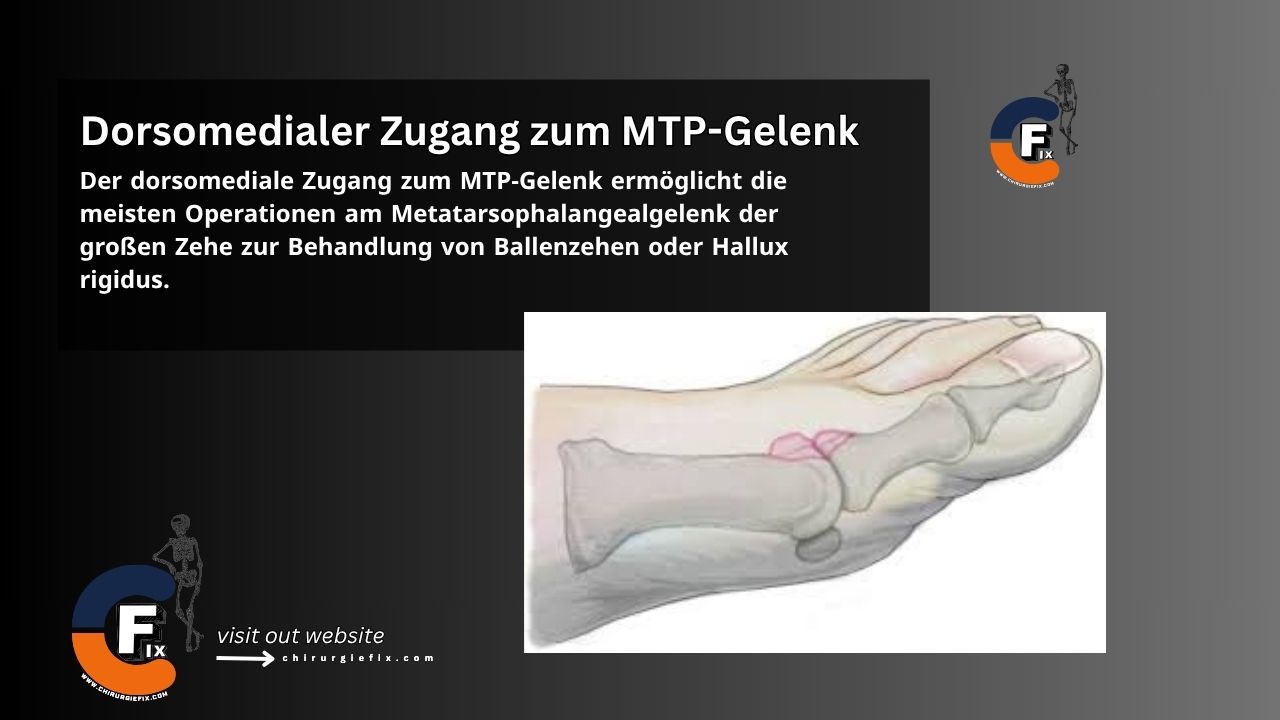
The dorsomedial approach to the MTP joint provides access for most surgeries on the metatarsophalangeal joint of the great toe, typically performed to treat bunions or hallux rigidus.

Indications

The dorsomedial approach to the MTP joint is indicated for the following procedures:

  1. Excision of the metatarsal head
  2. Excision of the proximal portion of the proximal phalanx
  3. Removal of metatarsal exostosis (bunionectomy)
  4. Osteotomy of the distal metatarsal
  5. Soft tissue correction for hallux valgus, including balancing procedures, tenotomies, and muscle reattachments
  6. Arthrodesis of the first metatarsophalangeal joint
  7. Joint replacement implantation
  8. Dorsal wedge osteotomy of the proximal phalanx for hallux rigidus

Patient Positioning

Place the patient supine on the operating table.

Landmarks and Incisions

Landmarks

  1. The head of the first metatarsal
  2. The metatarsophalangeal joint
  3. The tendon of the extensor hallucis longus muscle

Incisions

The dorsomedial approach to the MTP joint can be performed using one of the following incisions:

Dorsomedial Incision

  • The dorsomedial skin incision provides access to the exostosis on the metatarsal head without extensive skin retraction and is by far the most commonly used incision.
  • The bursa covering the exostosis may be inflamed, which can complicate the surgical procedure. Additionally, the skin on the medial side of the metatarsophalangeal joint is thinner than on the dorsal side and may not heal as well.
  • Begin the dorsomedial incision just proximal to the interphalangeal joint on the dorsomedial side of the great toe.
  • Curve it over the dorsal aspect of the metatarsophalangeal joint, staying medial to the extensor hallucis longus tendon.
  • Then angle the incision back, cutting along the medial side of the first metatarsal shaft, ending approximately 2 to 3 cm from the metatarsophalangeal joint.

Dorsal Incision

  • Begin the dorsal incision just proximal to the interphalangeal joint and directly medial to the extensor hallucis longus tendon.
  • Extend the incision proximally, parallel and just medial to the extensor hallucis longus tendon.
  • End the incision approximately 2 to 3 cm proximal to the metatarsophalangeal joint. Ensure the final incision is straight.

Internervous Plane

In the dorsomedial approach to the MTP joint, there is no true internervous plane. The bone lies subcutaneously, and the two nearby tendons—the extensor hallucis longus and the abductor hallucis—receive their nerve supply proximal to this approach, so they cannot be denervated.

Superficial Dissection

Dorsomedial Incision

  • Incise the deep fascia along the line of the incision. Then, cut down to the dorsomedial side of the metatarsophalangeal joint.
  • The often-visible dorsal digital branch of the medial cutaneous nerve is retracted laterally with the skin flap on the lateral wound edge.
  • Make a U-shaped incision in the joint capsule, leaving the capsule attached at the proximal end of the proximal phalanx.

Dorsal Incision

  • The deep fascia is divided along the incision line, and the extensor hallucis longus tendon is retracted laterally.
  • To enter the joint, incise the dorsal side of the joint capsule.
  • Note that the type and position of the capsulotomy depend on the specific procedure being performed.

Deep Surgical Dissection

  • For both incisions, the periosteum of the proximal phalanx and the first metatarsal is incised longitudinally.
  • Use blunt instruments to strip the coverings from the bones, taking care not to damage the flexor hallucis longus tendon, which lies within a fibro-osseous tunnel on the plantar surface of the proximal phalanx between the sesamoid bones.
  • The extent of deep dissection depends on the specific procedure being performed.
  • Remove only a minimum of periosteum from the bone. Do not strip all soft tissue attachments from the metatarsal if a distal osteotomy of this bone is planned, as this can devascularize the metatarsal head.

Approach Extension

The dorsomedial approach to the MTP joint cannot be meaningfully extended to other joints in the foot, but it can be extended proximally to provide access to the metatarsal shaft.

Dangers

Structures at risk during the dorsomedial approach to the MTP joint include:

  1. The extensor hallucis longus tendon
  2. The flexor hallucis longus tendon

References

  • Book "Surgical Exposures in Orthopaedics" – 4th Edition

Still to read...