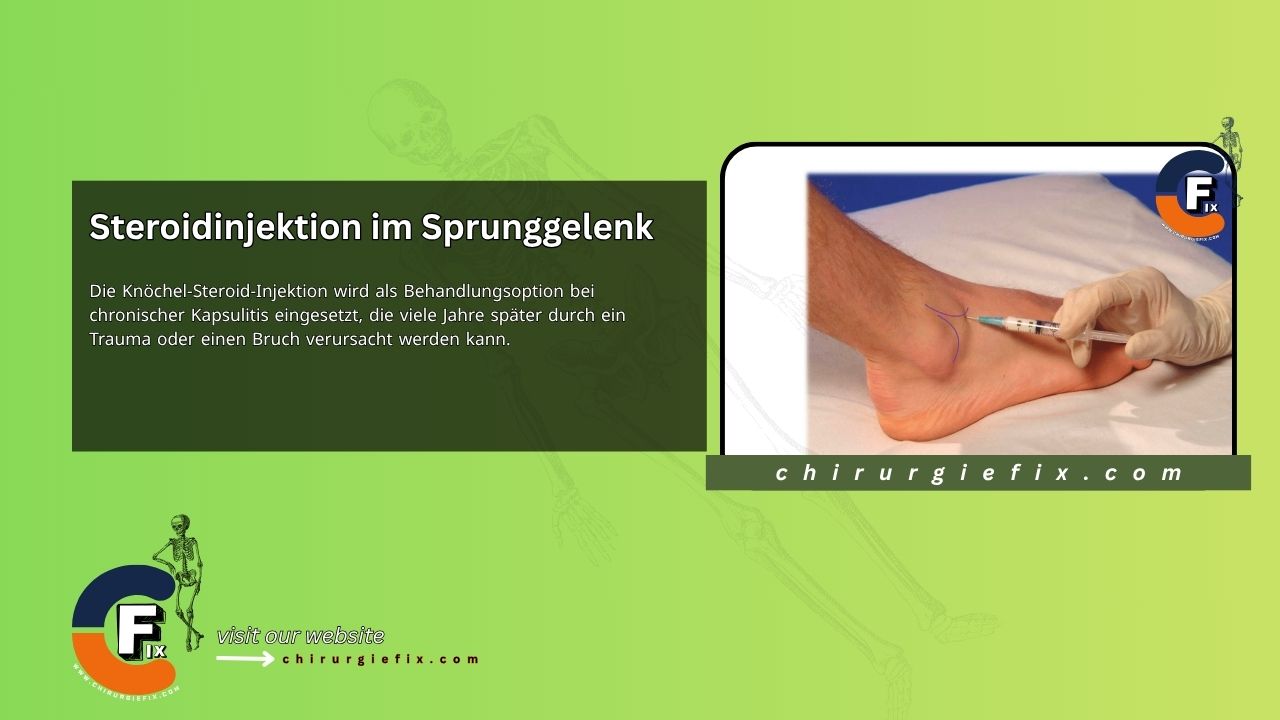
Steroid injection in the ankle joint

An ankle joint steroid injection is a treatment option for chronic capsulitis, a condition that may develop many years after an ankle trauma or fracture.

Chronic capsulitis of the ankle joint is characterized by pain on the front or inside of the ankle. Clinical presentation typically involves pain with passive plantarflexion rather than dorsiflexion, accompanied by a hard end-feel.

Required Equipment

  • Syringe: 2.5 ml
  • Needle: Blue, 23 gauge, 1.25 inches (30 mm)
  • Kenalog 40: 30 mg
  • Lidocaine: 1.75 ml, 2%
  • Total volume: 2.5 ml

Relevant Anatomy

The simplest and safest entry point to the ankle joint is at the junction of the tibia and fibula, just above the talus. A small triangular space can be palpated at this site.

Ankle Steroid Injection Technique

  • The patient lies with the knee bent at 90 degrees and the foot slightly plantarflexed.
  • Identify and mark the small triangular space by passively flexing and extending the ankle while palpating the gap between the base of the tibia and fibula.
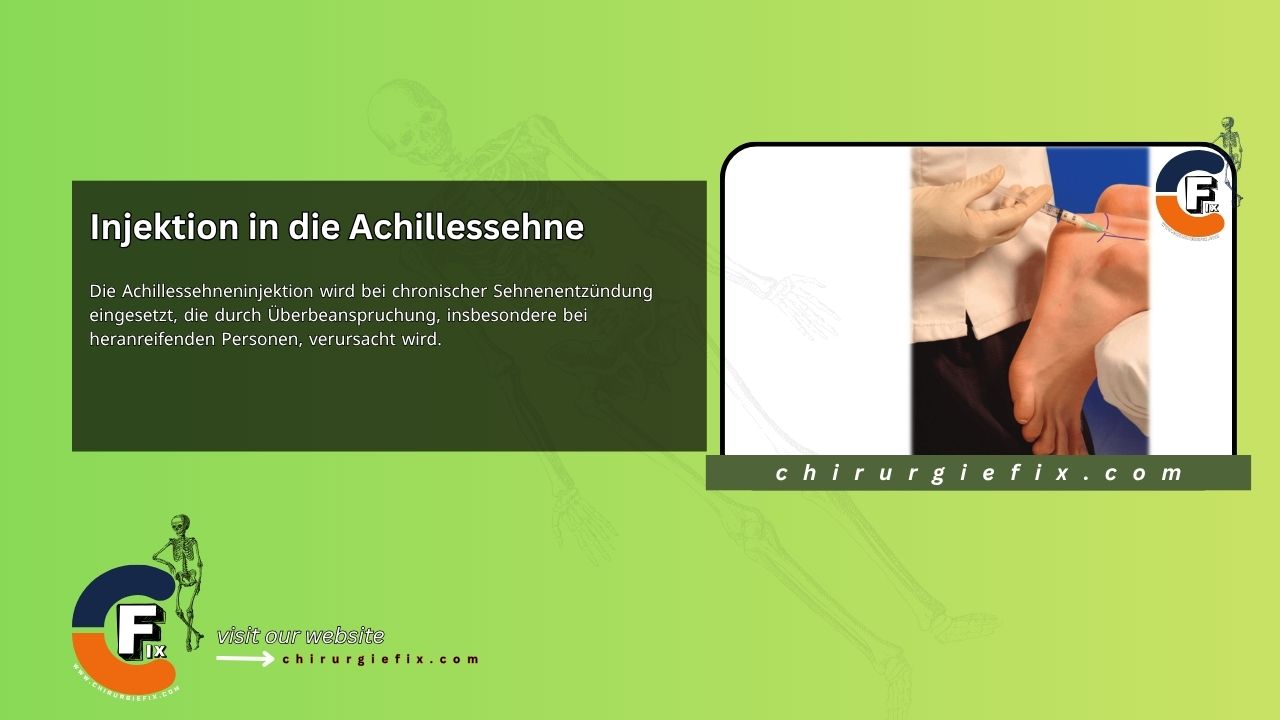
  • Insert the needle into the joint space at this location, angled slightly medially and proximally.
  • Administer the depot solution as a bolus.

Patients should avoid excessive weight-bearing activities until symptoms subside. Advise the patient that overuse can lead to symptom recurrence, and that long-distance running should therefore be limited.

Weight management is also recommended, and footwear should be assessed to ensure proper support. Appropriate orthotic inserts often help maintain pain-free walking. Begin with passive joint mobilization and strengthening of the dorsiflexors and evertors, and assess muscle balance around the ankle, as this is often a contributing factor.

Notes

  • Ultrasound and fluoroscopy are used to guide ankle injections. The ankle joint can be accessed from a dorsal approach, taking care to avoid the dorsalis pedis artery located between the tibialis anterior and extensor digitorum tendons. Using ultrasound makes it easier to spare the tendons. The ultrasound probe can be positioned longitudinally or transversely to assist needle placement. There are two approaches to accessing the joint: anteromedial or anterolateral.
  • The ankle joint rarely causes problems except after a severe trauma or fracture, and often only many years later.
  • An ankle steroid injection frequently provides reasonably lasting pain relief, provided excessive weight-bearing is avoided.
  • The ankle steroid injection can be repeated at intervals of at least 3 months if needed, with an annual x-ray to monitor for degenerative changes.

References

  1. Injection Techniques in Musculoskeletal Medicine. A Practical Handbook for Primary and Secondary Care Physicians. Fifth Edition.
  2. Drakonaki EE, Allen GM, Watura R. Ultrasound-guided intervention in the ankle and foot. Br J Radiol. 2016;89(1057):20150577. doi:10.1259/bjr.20150577. Epub 2015 Nov 5. PMID: 26537692; PMCID: PMC4985963.

Still to read...