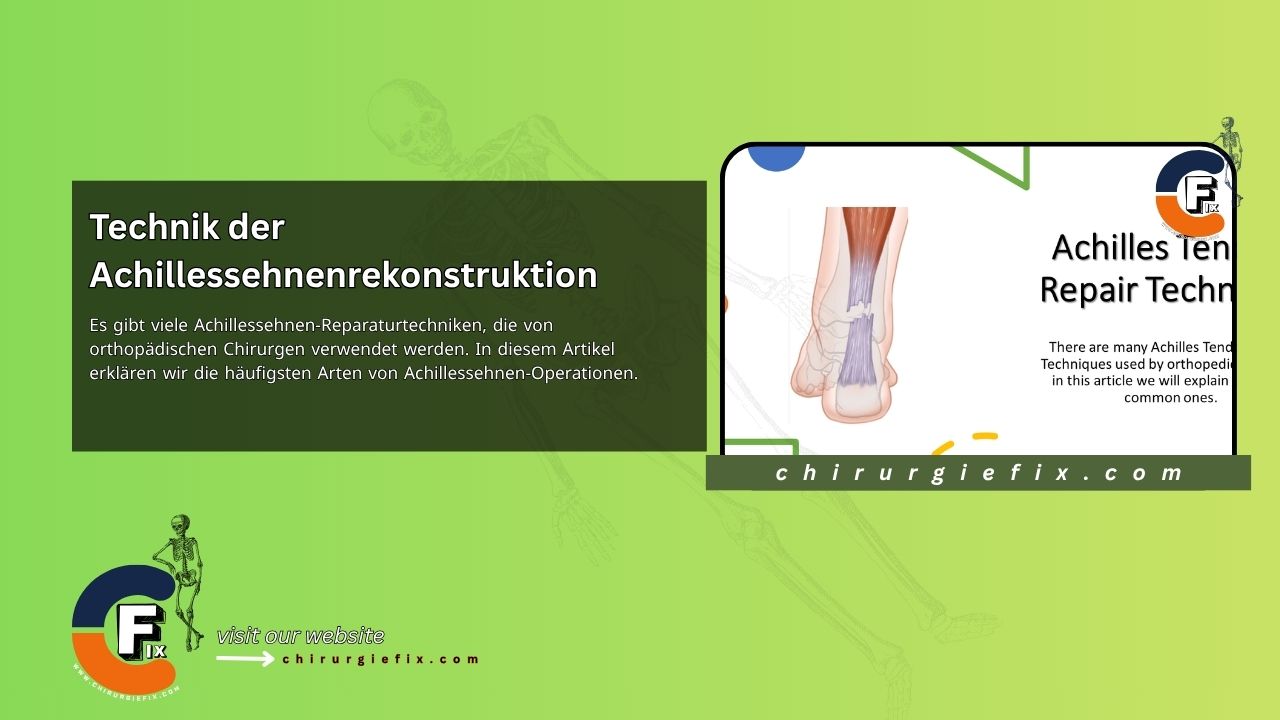
There are many Achilles tendon repair techniques used by orthopedic surgeons. This article explains the most common types of Achilles tendon surgeries.
Steps for the Achilles Tendon Repair Technique
Position the patient in a prone (face-down) position.
Make a posteromedial longitudinal incision, approximately 10 to 15 cm long, about 1 cm medial to the tendon. Ensure the incision ends just proximal to where the shoe counter meets the heel. This off-center incision helps prevent future shoe irritation directly over the tendon.
Make a sharp incision through the skin, subcutaneous tissue, and tendon sheath.
Reflect the tendon sheath together with the subcutaneous tissue to minimize subcutaneous dissection.
Suture the torn ends of the tendon using a non-absorbable #5 tension suture. Use a modified Kessler stitch through the stump, 2.5 cm from the rupture. Plantarflex the foot 0 to 5 degrees, flex the knee 15 degrees, and tie the tension suture to approximate the tendon ends.
Using a tendon stripper, harvest the plantaris tendon and release it proximally. Keep it in a moist sponge.
Position the frayed ends of the tendon as close to their normal position as possible. Repair the rupture using multiple resorbable 2-0 sutures both anteriorly and posteriorly.
Thread the previously harvested plantaris tendon through a fascial needle. Pass it circumferentially, first through the posterior and then the anterior part of the tendon, 2 cm from the rupture.
Secure the plantaris tendon to the Achilles tendon with several resorbable 2-0 sutures. If the distal tendon is long enough, fan it out and tack it over the repair site using Lynn’s technique.
Close the fascial sheath and subcutaneous tissue with 2-0 resorbable sutures.
Close the skin and apply a sterile dressing.
Apply a short leg cast with the foot in gravity equinus position.
Krackow Technique for Achilles Tendon Repair
With the patient prone, make a posteromedial incision about 10 cm long, about 1 cm medial to the tendon, ending proximal to where the shoe counter meets the heel.
Cut sharply through the skin, subcutaneous tissue, and tendon sheath. Reflect the tendon sheath with the subcutaneous tissue to minimize subcutaneous dissection.
Suture the torn ends of the tendon with a 2-0 non-absorbable suture.
Check the stability of the repair after the sutures are tied.
Close the peritenon and subcutaneous tissue with 4-0 resorbable sutures.
Close the skin and apply a sterile dressing with a posterior splint or short leg cast while the foot is in equinus.
Lindholm Technique for Achilles Tendon Repair
With the patient prone, make a posterior curvilinear incision extending from the mid-calf to the calcaneus.
Incise the deep fascia in the midline and expose the tendon rupture.
Clean the frayed ends of the tendon and secure them with a box mattress suture of heavy, non-absorbable material or wire. Also use fine interrupted sutures.
Create two flaps from the proximal tendon and gastrocnemius aponeurosis, each about 1 cm wide and 7 to 8 cm long. Leave these flaps attached at a point 3 cm proximal to the rupture site.
Rotate each flap 180 degrees on itself so its smooth outer surface lies next to the subcutaneous tissue as it is turned distally over the rupture.
Suture each flap to the distal tendon stump and to each other so that it completely covers the rupture site.
Close the wound, taking care to approximate the tendon sheath at the repair site.
References and Further Reading
Campbell's Operative Orthopaedics, 12th edition.
Gupta S, Salwan A Jr, Pisulkar GL, Saoji A, Taywade S. Surgical Repair of Achilles Tendon Ruptures by Turn-O-Plasty: A Case Report. Cureus. 2022 Sep 11;14(9):e29058. doi: 10.7759/cureus.29058. PMID: 36249636; PMCID: PMC9554371.
Xu L, Jin J, Liu Z, Wu M, Peng B, Jiang J, Liu G, He J, White S, Xia Y. A New Technique of Achilles Tendon Rupture Repaired by Double Transverse Mini-incision to Avoid Sural Nerve Injury: A Consecutive Retrospective Study. Orthop Surg. 2023 Feb;15(2):517-524. doi: 10.1111/os.13615. Epub 2022 Dec 26. PMID: 36573277; PMCID: PMC9891928.
Follow Us & Stay Updated!
Don't miss new scholarships, universities, orthopedic insights, physiotherapy resources, and medical education updates.