The technique for reducing a nursemaid's elbow is a straightforward sequence of movements used by orthopedic surgeons to correct a pulled elbow. This condition typically occurs in children under five years old, with cases reported in children aged between 3 and 73 months.
A nursemaid's elbow, also known as a "pulled elbow" in childhood, happens when an axial traction force (pulling) is applied to an abducted arm while the elbow is extended and pronated. This action can cause a tear in the incompletely developed annular ligament in young children.
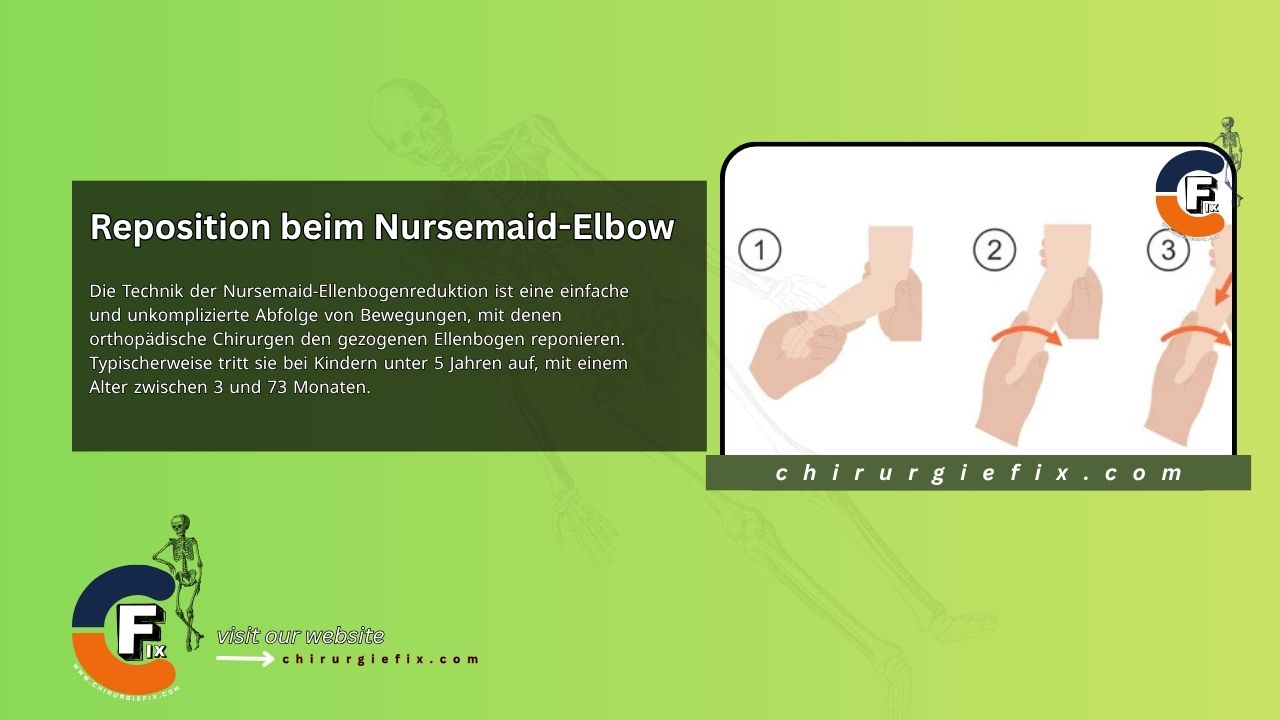
The supination-flexion maneuver involves supinating the wrist, followed by flexing the elbow. This is the standard technique for nursemaid's elbow reduction and is familiar to most physicians.
This reduction technique is performed as follows:
An alternative method is the pronation or hyperpronation technique (with or without flexion). This technique was originally described by Hutchinson as the preferred reduction method. The recommended version is a variation of the "handshake" maneuver described by Lyver.
The hyperpronation technique for nursemaid's elbow reduction is as follows:
Several prospective studies have compared these two techniques. McDonald found that overall success rates were similar between the two nursemaid's elbow reduction maneuvers. However, the study found that hyperpronation was more successful when the left arm was affected, and physicians performing the procedure rated it as less painful.
A palpable or audible click indicates that the annular ligament has been reduced with either technique.
Typically, the child may cry briefly at the moment of reduction, after which the affected arm can be used fully within 30 minutes.
If the first attempt at nursemaid's elbow reduction is unsuccessful, a second attempt should be made using the same technique. If the second attempt fails, the alternative technique should be tried. If reduction is still not achieved, a posterior splint should be applied, and a referral to a pediatric orthopedist for follow-up in a few days should be arranged.
Parents should be informed that a nursemaid's elbow can recur until the distal attachment of the annular ligament to the radial neck is fully developed, which typically occurs around age 5.
It is acceptable to teach parents the reduction technique that was successful so they can attempt it before seeking medical care. Additionally, it is helpful to discuss the mechanism that caused the injury with parents and recommend avoiding the activity that led to the injury, if possible.
Applying a splint or sling for a patient who can fully use their affected arm after nursemaid's elbow reduction is unnecessary and is not recommended, even in cases of recurrent nursemaid's elbow dislocations, which can occur with a frequency of up to 25 percent.