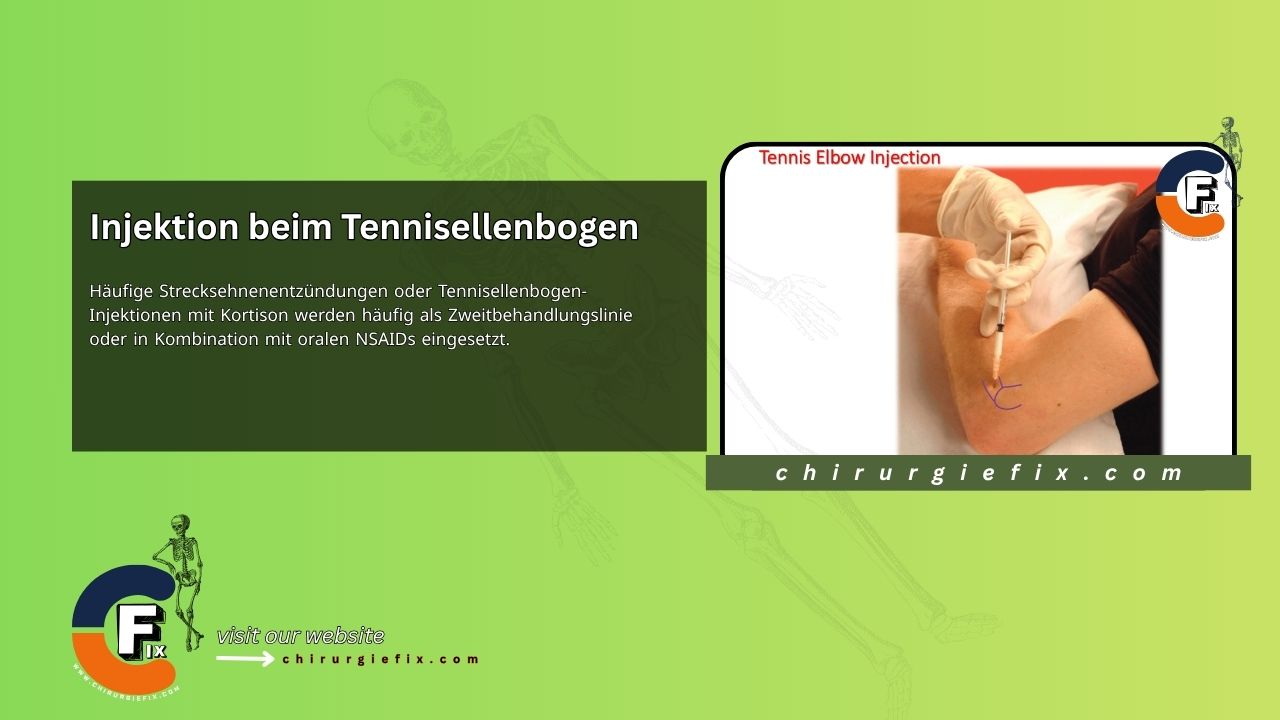
Corticosteroid injections for common extensor tendinopathy, often known as tennis elbow, are frequently used as a second-line treatment or in combination with oral NSAIDs. Research indicates that a cortisone injection for tennis elbow, when combined with both topical and oral NSAIDs, is more effective than using topical and oral NSAIDs alone.
Common extensor tendinopathy, or tennis elbow, is characterized by pain on the outer side of the elbow. This pain is typically aggravated by gripping and twisting movements. Key signs include painful resisted wrist extension with the elbow straightened, and passive wrist flexion with ulnar deviation.
In addition to standard skin sterilization, the following equipment is required for a tennis elbow injection:
Tennis elbow always occurs at the teno-osseous origin, or enthesis, of the common extensor tendon at the elbow. The tendon originates from the anterior flat facet of the lateral epicondyle, an area roughly the size of a small fingernail.
Rest the elbow for at least 10 days. Any lifting should be done with the palm facing upward to engage the flexor muscles rather than the extensors. The activity that caused the condition must be avoided. Once resisted extension is pain-free, two or three sessions of deep friction massage, combined with a strong stretching manipulation (Mill’s manipulation), can be performed to help prevent recurrence.
Following this, a gradual program of self-stretching for the extensors and strengthening exercises should be introduced. If the cause was a racquet sport, the racquet’s weight, grip size, string tension, and the player’s technique should be reviewed. Consulting a professional coach may be beneficial. Sustained static postures at work should also be avoided.
This is a very common injectable lesion with a tendency for recurrence. Recurrence is often not due to a failed injection, but rather because the patient returns to their sport too quickly after the symptoms subside.
While the teno-osseous junction is the most common site, the lesion can also occur in other parts of the extensor muscle complex. Ignore sensitive trigger points within the tendon body, which are present in everyone, and place the needle precisely on the very small lesion site. While repetitive strain injury can include true tennis elbow, nerve gliding, relaxation techniques, cervical spine mobilization, and postural advice can be effective when the tendon itself is clear.
A single cortisone injection is usually sufficient for tennis elbow. However, if symptoms recur, a second injection can be given, followed by the post-injection routine outlined above 10 days later.
Ensure the needle is very firmly attached to the syringe to avoid spraying the solution onto both the patient and the practitioner.
For recurrent tendinitis, a sclerosing agent injection or a tenotomy may be considered. In thin patients, particularly those with darker skin, there is a risk of depigmentation and/or subcutaneous atrophy. Patients should be informed of this before giving consent. Hydrocortisone should be used if the patient is concerned about these potential side effects.
Golfer’s elbow is characterized by pain on the inner side of the elbow, which is aggravated by gripping and lifting. Signs include painful resisted wrist flexion and, occasionally, resisted forearm pronation.
The common flexor tendon at the elbow originates from the anterior facet of the medial epicondyle. At its teno-osseous origin, it is approximately the size of a small fingernail.
Advise a relative rest period of about 10 days. After this, stretching and strengthening exercises for the flexor and extensor muscles can be started. Deep transverse friction massage can also be performed.
Occasionally, the lesion occurs at the musculotendinous junction, which is almost always a very tender point. Infiltration at this point may not be as effective, but deep friction massage can be successful if the patient tolerates it.
This lesion is far less common than tennis elbow and is less prone to recurrence. Therefore, follow-up treatment with deep friction massage and manipulation does not seem to be necessary.