Reconstruction of the ulnar collateral ligament at the elbow

Understanding Ulnar Collateral Ligament Reconstruction of the Elbow

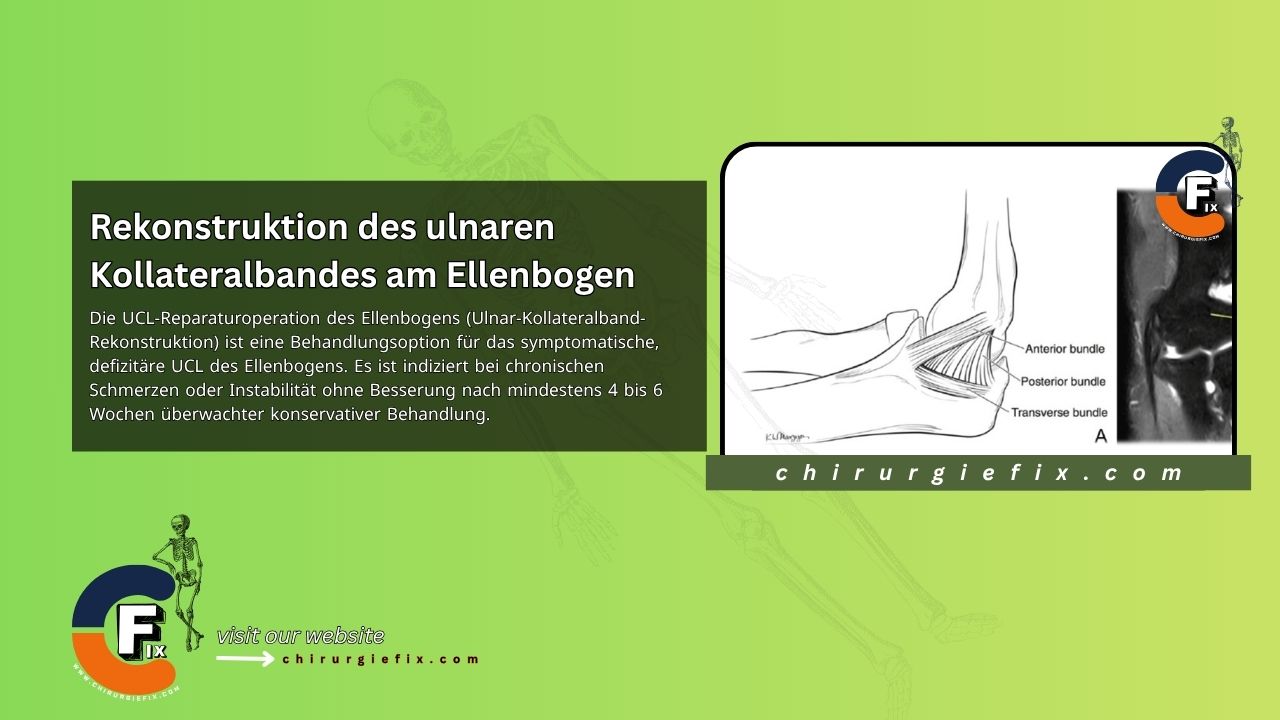
UCL repair surgery of the elbow, also known as ulnar collateral ligament reconstruction, is a treatment option for a symptomatic, deficient UCL of the elbow. It is indicated for chronic pain or instability that has not improved after at least 4 to 6 weeks of supervised conservative treatment.

The ulnar collateral ligament is the primary restraint against valgus stress on the elbow. Injury to this ligament can result from traumatic events or from wear-and-tear changes, which are common in overhead athletes and lead to pain and discomfort.

Key Technical Points

When performing a UCL repair operation, several important technical points must be considered:

  • Calcifications should be removed from the ligament.
  • The drill holes must correspond to the attachment sites of the ulnar collateral ligament.
  • The graft should not rub against the epicondyle or the ulna, and the ends of the graft should be buried in the tunnels.
  • The figure-eight configuration of the graft provides strength and mimics the biomechanics of the ulnar collateral ligament.
  • Careful handling of the medial antebrachial cutaneous nerve, the ulnar nerve, their branches, and their vascular supply is essential.

Surgical Steps for Elbow UCL Repair (Jobe Technique)

  • Apply a pneumatic tourniquet.
  • Place the arm on an arm board with the elbow extended and a rolled towel underneath. Prepare the contralateral arm and ipsilateral leg for graft harvest if needed.
  • Make a 10 cm incision over the medial epicondyle.
  • Protect the medial antebrachial cutaneous nerve and incise the mass of the flexor pronator muscle in the posterior third to expose the ulnar collateral ligament.
  • Split the muscle without detaching it, and incise the ulnar collateral ligament to assess the quality of the ligament and the joint.
  • Retract the ulnar nerve gently until it releases from the bone to allow drilling of the holes. Do not transpose the nerve.
  • Using a 3.2 mm drill at slow speed with a tissue protector, drill anterior and posterior holes in the proximal ulna. Leave a 1 cm bone bridge. Drill the tunnel at the level of the coronoid tubercle. In the medial epicondyle, use a 4 mm drill to create a 1 cm common anterior hole at the origin of the ulnar collateral ligament. Then, use a 3.2 mm drill to create diverging tunnels (a lazy "Y") that exit 0.5 cm apart anterior to the intermuscular septum.
  • Obtain a 15 cm graft from the palmaris longus tendon, plantaris tendon, or Achilles tendon. Place a 1:0 non-absorbable suture through each end of the graft and pass it in a figure-eight pattern through the tunnels.
  • Remove the rolled towel from under the elbow. Tension and suture the graft with the elbow in neutral (varus-valgus) and 45 degrees of flexion. Assess the range of motion. Suture the graft to the remnants of the ulnar collateral ligament.
  • If ulnar nerve symptoms and significant scar tissue are present, a transposition of the ulnar nerve may be necessary. Elevate the flexor-pronator muscle mass, leaving a ring of soft tissue on the medial epicondyle. Decompress the nerve proximally at the Struthers' arcade and distally at the end of the intermuscular septum to avoid devascularization. Transpose the nerve anterior to the epicondyle and reattach the flexor-pronator mass to the epicondyle, superficial to the transposed nerve.
  • Release the tourniquet and achieve hemostasis. Bathe the nerve with dexamethasone solution (Decadron) and perform routine subcutaneous and skin closure.
  • Apply a padded posterior splint with the elbow flexed to 90 degrees and in neutral rotation, leaving the wrist and hand free.

Postoperative Care

  • After UCL repair surgery, the elbow is immobilized in a posterior splint for 10 days.
  • Gentle hand grip exercises are started as soon as the patient is comfortable.
  • Active range of motion exercises for the elbow and shoulder begin after 10 days, with wrist and forearm strengthening exercises starting at 4 to 6 weeks.
  • Elbow strengthening exercises begin after 6 weeks, but valgus stress on the elbow is avoided until 4 months after surgery.
  • Athletes may start a progressive, supervised throwing program.
  • This is followed by a progressive forearm and shoulder strengthening program, along with a general conditioning program.
  • Return to competitive pitching is allowed after approximately one year.

References and Further Reading

  1. Morrey BF, An KN. Articular and ligamentous contributions to the stability of the elbow joint. Am J Sports Med. 1983;11:315–319. doi: 10.1177/036354658301100506.
  2. Torres SJ, Limpisvasti O. Ulnar Collateral Ligament Repair of the Elbow – Biomechanics, Indications, and Outcomes. Curr Rev Musculoskelet Med. 2021 Apr;14(2):168-173. doi: 10.1007/s12178-021-09698-4. Epub 2021 Feb 9. PMID: 33559839; PMCID: PMC7991021.
  3. Erickson BJ, Harris JD, Chalmers PN, Bach BR Jr, Verma NN, Bush-Joseph CA, Romeo AA. Ulnar Collateral Ligament Reconstruction: Anatomy, Indications, Techniques, and Outcomes. Sports Health. 2015 Nov-Dec;7(6):511-7. doi: 10.1177/1941738115607208. Epub 2015 Sep 22. PMID: 26502444; PMCID: PMC4622381.

Still to read...