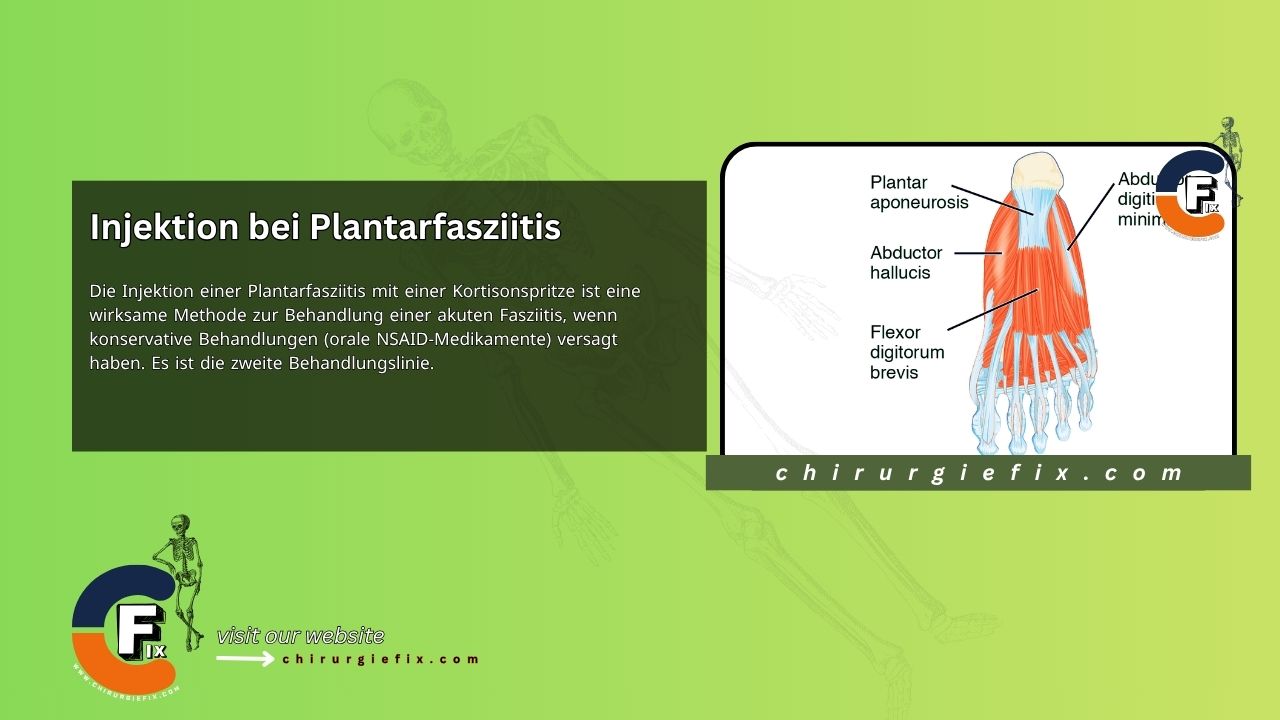
Corticosteroid injections are an effective treatment for acute plantar fasciitis when conservative treatments, such as oral NSAIDs, have failed. This approach is considered a second-line therapy.
Acute fasciitis is a condition marked by pain and inflammation in the heel area. Causes can include idiopathic factors, overuse, obesity, or wearing unsuitable footwear. On clinical examination, pain is typically felt on the inner side of the heel pad, especially during the first steps in the morning. Tenderness is also present along the medial edge of the fascia where it attaches to the heel bone. Accurate diagnosis and effective treatment are essential in orthopedic practice.
Related Anatomy
The plantar fascia is the thick central portion of the fascia that envelops the plantar muscles. It extends from the medial process of the calcaneal tuberosity to the proximal phalanges of the toes, providing some attachment for the toe flexor muscles.
Distally, the plantar fascia transitions into the fibrous sheaths that encase the flexor tendons as they travel to the toes. At the forefoot, beneath the metatarsal heads, the plantar aponeurosis forms the superficial transverse metatarsal ligament.
Required Equipment
- Syringe: 2 ml
- Needle: Green, 21 gauge, 2 inches (50 mm)
- Kenalog 40: 20 mg
- Lidocaine: 1.5 ml, 2%
- Total volume: 2 ml
Plantar Fasciitis Injection Technique
The plantar fasciitis injection procedure involves the following steps:
- Position the patient: Place the patient in a prone (face-down) position, holding the foot securely in strong dorsiflexion. This positioning helps provide better access to the target area.
- Locate the tender point: Identify the area of maximum tenderness on the medial side of the heel. This is where the plantar fascia, a thick band of tissue supporting the arch, typically originates.
- Prepare for injection: Sterilize the injection site and assemble the necessary equipment, including the syringe and appropriate needle. Ensuring all equipment is sterile is critical to minimize infection risk.
- Insert the needle: Insert the needle perpendicularly into the soft part of the sole, just distal to the heel pad. Then, advance the needle at a 45-degree angle toward the calcaneus until it contacts the bone. This angle helps ensure proper placement and targeting of the affected area.
- Administer the solution: Inject the medication, typically a corticosteroid or local anesthetic, into the fascia at its medial bony origin. The injection is usually performed in two lines, effectively delivering the medication along the fascia.
After a plantar fasciitis injection, we recommend using gel heel lifts in both boots for men or low-heeled shoes for women, followed by intrinsic muscle training and daily active stretching of the fascia. Rolling the foot over a golf ball or a firm squash ball can help create strong friction, and orthotics or taping may also be applied.
Notes
The best treatment for plantar fasciitis combines corticosteroid injections with exercise (strengthening and stretching). This combined approach is superior in both the short and long term. Corticosteroid injections combined with controlled exercise are recommended as a first-line treatment for patients with plantar fasciitis, according to a single-blind, randomized, controlled trial.
The classic symptom is pain under the heel when bearing weight on the foot first thing in the morning.
While this may seem like a very painful injection, this method is much gentler than directly puncturing the heel pad with the needle. Patients usually tolerate it surprisingly well, and administering a few drops of the solution as the needle passes through the tissue creates an anesthetic effect.
Heel spurs are frequently observed on X-rays of this region and may be an incidental finding. If a heel spur is the underlying cause, the patient will experience more pain with weight-bearing. Using a pad with a hole cut in the center may relieve symptoms, but surgical intervention might be considered.
Risks associated with plantar fasciitis injection may include:
- Connective tissue rupture: Steroid injections can weaken tendons, potentially leading to a connective tissue rupture, similar to a tendon tear. This risk persists for up to 14 days after the injection.
- Collagen necrosis: Steroids can cause collagen necrosis in tendons, compromising their strength and integrity.
- Suppression of cell metabolism and collagen synthesis: Glucocorticoids can suppress cell metabolism and collagen synthesis in tenocytes, the cells responsible for tendon maintenance and repair.
- Suppression of proteoglycan synthesis: Steroids can also suppress proteoglycan synthesis, which is important for the fibrillogenesis of the extracellular matrix and collagen matrix. Reduced proteoglycan synthesis may contribute to the risk of spontaneous rupture.
- Plantar fascia rupture: Complications associated with plantar fasciitis injection include plantar fascia rupture. A fascial rupture disrupts normal foot function and can promote further inflammation and pain.
- Atrophy of the plantar fat pad: Steroid injections can lead to atrophy of the plantar fat pad, reducing subcalcaneal cushioning. This can increase the vulnerability of the plantar fascia to injury and lead to more pain.
- Injury to the lateral plantar nerve: Injection-related injury to the lateral plantar nerve can occur as a complication of steroid injections for plantar fasciitis.
- Calcaneal osteomyelitis: Although rare, calcaneal osteomyelitis (infection of the heel bone) has been reported as a possible complication of steroid injections for plantar fasciitis.
- Skin burn (with iontophoresis): Iontophoresis, a method of delivering medication through the skin using an electric current, can cause a burn to the underlying skin.
References and Further Reading
- Injection Techniques in Musculoskeletal Medicine. A Practical Manual for Clinicians in Primary and Secondary Care. Fifth Edition.
- Johannsen FE, Herzog RB, Malmgaard-Clausen NM, Hoegberget-Kalisz M, Magnusson SP, Kjaer M. Corticosteroid injection is the best treatment in plantar fasciitis if combined with controlled training. Knee Surg Sports Traumatol Arthrosc. 2019 Jan;27(1):5-12. doi: 10.1007/s00167-018-5234-6. Epub 2018 Nov 15. PMID: 30443664.
- Tatli YZ, Kapasi S. The real risks of steroid injection for plantar fasciitis, with a review of conservative therapies. Curr Rev Musculoskelet Med. 2009 Mar;2(1):3-9. doi: 10.1007/s12178-008-9036-1. Epub 2008 Sep 19. PMID: 19468912; PMCID: PMC2684947.